Inventory Management
Zoho Inventory Alternatives: Best Inventory Management Software to Consider
· 9 min read
Finding the right inventory platform is not only about counting products. As stock, suppliers, purchase orders, warehouses, and day-to-day transactions increase, businesses need a system that fits the way they actually operate.
That is why many teams research Zoho Inventory Alternatives before making a final software decision. They may be looking for different inventory workflows, broader ERP capabilities, stronger multi-location control, or software that fits a particular industry.
If you are searching for a Zoho Inventory competitor, the right choice will depend on your stock processes, number of locations, purchasing requirements, integrations, and the level of automation you need.
This guide compares several established options so you can narrow down the choices without getting distracted by features that do not matter to your business.
What Is Zoho Inventory?
Zoho Inventory is an inventory management platform that helps businesses manage stock, purchasing, warehousing, orders, and fulfillment. Its current feature set includes purchase orders and purchase receives, multi-warehouse management, transfer orders, item groups, serial and batch tracking, barcode tools, inventory adjustments, and order management. Zoho's official product documentation provides the current feature details.
It can be a practical option for businesses that want inventory and order processes managed through a dedicated inventory platform.
At the same time, not every organization has the same operating model. A business managing several facilities may prioritize site-level stock visibility, while an accounting-led business may want inventory tightly connected with financial workflows.
That is where comparing alternatives becomes useful.
Why Consider Zoho Inventory Alternatives?
Different inventory requirements
A small product-based business may need straightforward stock and order management. A multi-site organization may need purchasing, stock transfers, vendor controls, approvals, and visibility across several properties.
The software should match those workflows instead of forcing the business to change everything around the tool.
Multi-location operations
Businesses operating from several warehouses, stores, plants, or facilities often need a clear view of stock at each location. Stock transfers and centralized reporting can become important as the number of locations increases.
Broader business management
Some businesses want inventory to work closely with accounting, purchasing, manufacturing, sales, or other operational functions. In that situation, an ERP platform can be worth considering alongside dedicated inventory software.
Industry-specific workflows
Inventory requirements can differ significantly between retail, distribution, manufacturing, and facility management. A platform that fits one environment may not be the best match for another.
Scalability
The system should continue to make sense as the number of items, transactions, users, vendors, and locations grows. Reviewing scalability before implementation can help avoid another software change later.
Best Zoho Inventory Alternatives
1. Firmity
Firmity is a cloud-based facility management platform that combines CMMS and ERP capabilities, including inventory and vendor automation. Its inventory module is designed around the needs of organizations managing stock, spare parts, purchases, and usage across facilities and properties.
The platform connects inventory activities from requisition and purchasing through goods receipt and stock distribution. Teams can organize items by category, sub-category, and specifications, while setting minimum stock thresholds for individual items.
Firmity also supports vendor rate cards, purchase orders and approvals, goods receipt notes (GRNs), stock ledgers, and stock transfers. This gives teams a connected record of inventory movements instead of relying on separate registers or spreadsheets.
Another useful aspect is multi-property visibility. Teams can view stock across stores and properties from one platform, which can be relevant when maintenance materials, spare parts, and consumables are distributed across multiple sites.
Best suited for: Facility management companies, manufacturing facilities, educational campuses, residential estates, and other multi-site organizations that need inventory management alongside broader facility operations.
You can explore Firmity's Inventory Management Software or contact the Firmity team if you want to evaluate how it fits your operations.
2. TallyPrime
TallyPrime combines accounting and business management with inventory capabilities, making it a familiar option for many businesses in India.
Its inventory features include stock groups and categories, multiple locations or godowns, flexible units of measure, batches, reorder levels, inventory reports, and stock movement tracking. TallyPrime can also connect inventory processes with accounting and other business transactions.
This makes it useful for organizations that do not want inventory management to sit separately from their financial records.
Best suited for: Businesses that want inventory management closely connected with accounting, billing, purchasing, sales, and financial reporting.
3. ERPNext
ERPNext is an open-source ERP platform with a dedicated Stock module. Its inventory functionality covers stock levels, warehouse management, item management, stock receipts, deliveries, transfers, reconciliation, and inventory reporting.
ERPNext also supports serial and batch tracking, which can be useful when businesses need more detailed traceability for particular items.
Because inventory is part of a wider ERP environment, businesses can consider ERPNext when they want stock processes connected with broader business operations.
Best suited for: Organizations looking for an ERP platform that brings inventory together with purchasing, accounting, manufacturing, sales, and other business functions.
4. Odoo Inventory
Odoo Inventory is designed to help businesses organize day-to-day stock and warehouse activities within the Odoo platform. It can be used to monitor products, manage incoming and outgoing goods, and keep inventory records organized across different locations.
Businesses can use Odoo for activities such as stock transfers, replenishment, product tracking, barcode-based operations, and warehouse workflows. Its connection with other Odoo applications can also help businesses keep inventory-related processes linked with areas such as purchasing and sales.
Best suited for: Businesses that want inventory and warehouse management alongside other connected business applications.
5. SAP Business One
SAP Business One is an ERP solution for small and midsize businesses that includes purchasing, inventory, sales, financial management, reporting, and analytics.
Its purchasing and inventory capabilities support processes such as purchase orders, goods receipts, returns, item information, warehouse and accounting integration, and inventory reporting.
It is therefore more than a standalone inventory application. Businesses considering it are usually evaluating a wider ERP environment.
Best suited for: Small and midsize businesses that need inventory as part of a comprehensive ERP system.
6. Marg ERP
Marg ERP is an Indian business software option used for functions including billing, accounting, and inventory management. It can be considered by businesses that want stock management connected with their regular sales and financial processes.
When evaluating Marg ERP against Zoho Inventory, businesses should look at the specific workflows they need, including stock handling, purchasing, sales, reporting, and location management.
Best suited for: Retailers, wholesalers, distributors, and other businesses that want inventory functionality alongside billing and accounting processes.
7. Vyapar
Vyapar is a business management application that combines invoicing, accounting, and stock management. Its official product information highlights stock management and business reporting alongside invoicing and other business functions.
For businesses with relatively straightforward inventory workflows, combining billing and stock records in one application can be convenient.
Best suited for: Small businesses, retailers, and traders looking for inventory features alongside billing and basic business management.
8. inFlow Inventory
inFlow Inventory focuses on inventory and stockroom operations. Its feature set includes stock management, sales and purchase tracking, product organization, barcoding, and support for lot numbers and expiry dates in applicable plans.
It can be considered by businesses that want a dedicated inventory platform rather than a broad ERP suite.
Best suited for: Small and midsize product-based businesses that need dedicated inventory, purchasing, sales, and stockroom capabilities.
If you want to compare more inventory platforms and their capabilities, see our guide to Best Inventory Management Software
What to Compare When Choosing a Zoho Inventory Alternative
Inventory tracking
Start with the basics. Check how the software records stock receipts, issues, adjustments, transfers, and current quantities.
Purchase order management
If procurement is a major part of your workflow, look at how purchase orders are created, approved, received, and tracked.
Warehouse and location management
Businesses with multiple stores, warehouses, plants, or facilities should check whether the software provides clear location-wise stock visibility and transfer management.
Low-stock monitoring
Look for ways to identify items that are approaching their required minimum level. This can make replenishment planning easier.
Barcode and item tracking
If your team handles a large number of items, barcode, serial number, batch, or other identification features may reduce manual work.
Vendor management
Compare how each platform handles supplier information, purchasing records, vendor pricing, and related procurement activities.
Reporting
Good inventory reporting should help teams understand stock levels, movement, purchasing activity, and other information needed for routine decisions.
Integrations
Check whether the software can work with the accounting, sales, purchasing, ERP, facility, or other systems your business already uses.
Scalability
Think beyond today's inventory volume. Consider future users, locations, vendors, items, and transactions before making a decision.
How to Choose the Right Zoho Inventory Alternative
Start by documenting your current inventory process.
Write down how stock is received, stored, issued, transferred, counted, and reordered. This gives you a practical checklist for evaluating each product.
Next, identify where your current process causes delays or manual work.
For example, you may need better location-wise visibility, stronger purchase controls, easier stock transfers, or a more connected procurement process.
Then compare the shortlisted platforms against those specific requirements.
Do not choose software simply because it has the longest feature list. A system that fits your daily workflow is usually more useful than one with dozens of capabilities your team will never use.
Finally, consider implementation, user adoption, support, integration, and long-term scalability alongside the software's feature set and pricing.
Why Firmity Can Be a Zoho Inventory Alternative
Firmity is worth considering when inventory is closely connected with facility and property operations.
Its inventory module supports item cataloguing, minimum stock thresholds, vendor rate cards, purchase orders, approvals, GRNs, stock ledgers, and stock transfers.
The platform also connects requisitions, purchase orders, GRNs, and stock movements, helping teams maintain an auditable trail from procurement through distribution.
For organizations managing multiple facilities, centralized visibility across stores and properties can make inventory control easier to coordinate.
This is particularly relevant when inventory includes maintenance materials, spare parts, and consumables that need to move between locations.
If your broader goal is to evaluate the best inventory management software for facility or multi-site operations, Firmity can be included in that shortlist.
For a broader comparison of inventory platforms, you can also explore our guide to Best Inventory Management Software.
You can contact Firmity to discuss your inventory and facility management requirements.
Final Thoughts
There is no single inventory platform that is the right fit for every business.
Zoho Inventory is one option, but the best alternative depends on what your organization actually needs from its inventory process.
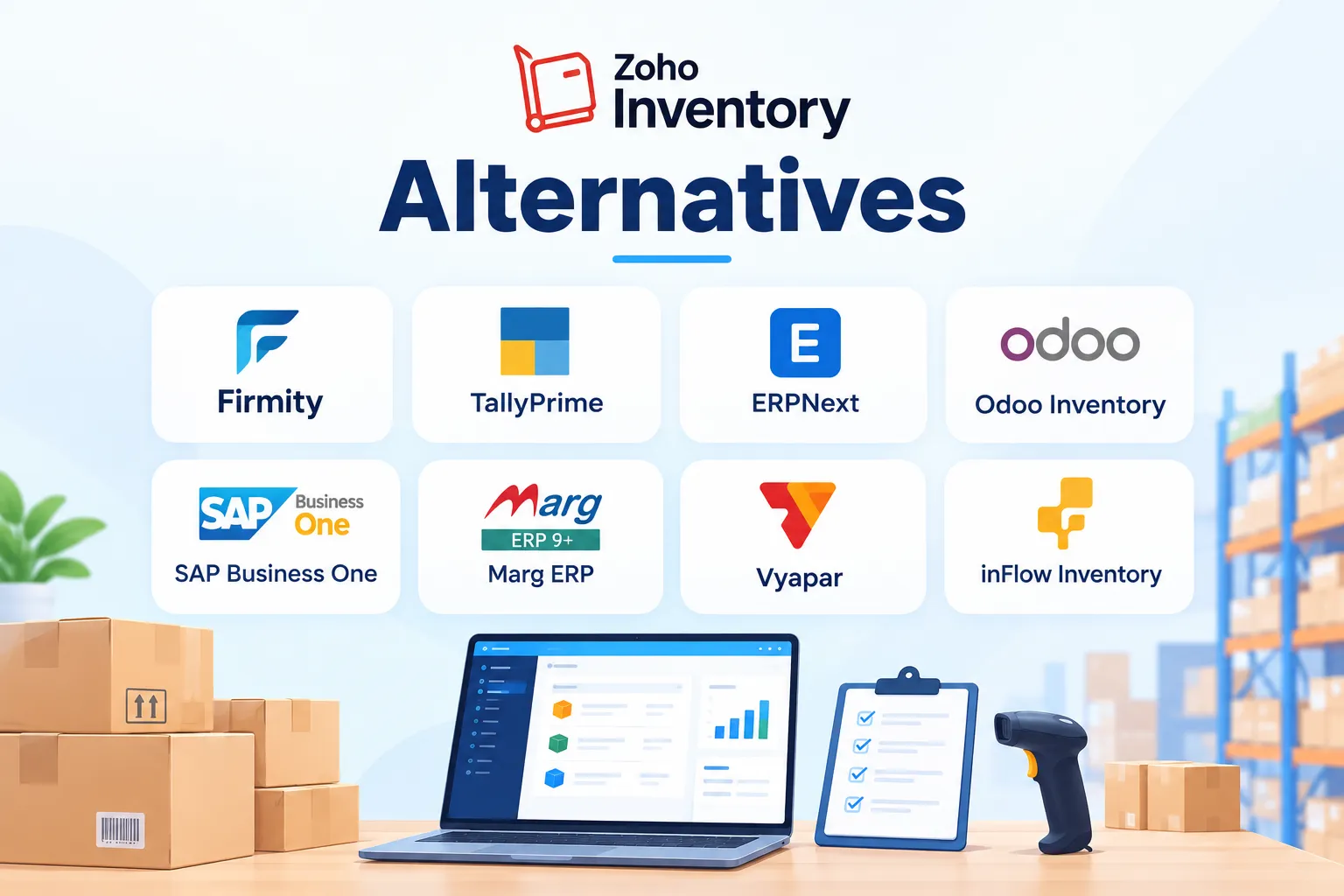
TallyPrime can make sense when accounting and inventory need to work closely together. ERPNext and Odoo can suit businesses looking for broader ERP ecosystems. SAP Business One is aimed at organizations evaluating a wider ERP solution. Vyapar can suit smaller businesses with straightforward stock and billing needs, while inFlow focuses more directly on inventory operations.
For facility management and multi-site organizations, Firmity offers another approach by bringing inventory and spare-parts management together with wider facility operations.
Instead of focusing only on the number of features, consider how well the software supports your actual inventory processes. The right choice should match how your team handles purchasing, receiving, storage, stock movement, usage, and day-to-day inventory control.
FAQs About Zoho Inventory alternatives
The right alternative depends on your business requirements. Firmity, TallyPrime, ERPNext, Odoo Inventory, SAP Business One, Marg ERP, Vyapar, and inFlow Inventory are options worth evaluating for different inventory and business workflows.
The right alternative depends on your business requirements. Firmity, TallyPrime, ERPNext, Odoo Inventory, SAP Business One, Marg ERP, Vyapar, and inFlow Inventory are options worth evaluating for different inventory and business workflows.
Yes, Zoho Inventory offers a free plan with limited features, including 50 orders per month, one user, and one location, making it suitable for basic inventory management needs.
Author Bio

Syed Aadam
Syed Aadam is a software engineer with a Bachelor's and Master's in Information Technology with a specialization in Artificial Intelligence and Machine Learning. Having trained, and assisted in training foundational ML models for solving frontier scientific problems at the intersection of biodiversity and technology, Syed Aadam has been working to develop AI-enabled CMMS, ERP and CAFM softwares at Ufirm Technologies.
Talk to our team
Questions about facility management software? Leave your details and we'll get back to you within 24 hours.