Payroll Management
Best Payroll Management Software in India: Top Payroll Software
· 9 min read
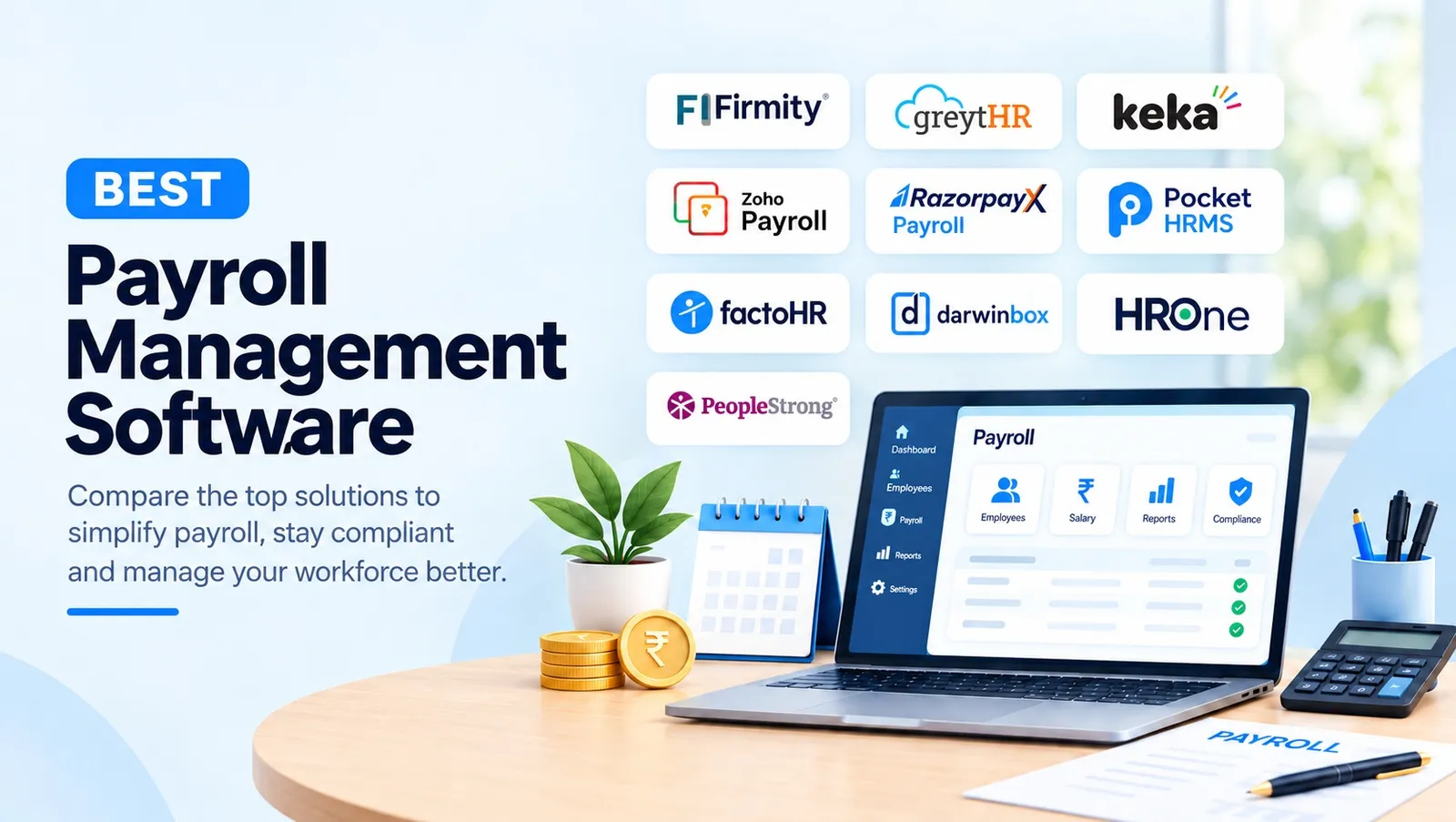
Choosing the best payroll management software can make monthly salary processing much easier, especially when a business has multiple employees, locations, attendance systems, leave records, reimbursements, and compliance requirements to manage.
Instead of handling spreadsheets and repeated calculations, payroll software brings employee information, salary structures, attendance inputs, deductions, payslips, reports, and other payroll activities into a centralized system.
But every business has different requirements. A small company may need simple payroll processing, while a large organization may need multi-location payroll, complex salary structures, approval workflows, integrations, and detailed reporting.
Here are some payroll software options businesses in India can evaluate based on their features, workflows, and organizational requirements.
Top Payroll Management Software in India
1. Firmity
Firmity payroll management software is designed to connect payroll activities with broader workforce and facility operations.
For organizations managing employees across multiple properties or locations, having employee, attendance, leave, salary, and operational information connected can reduce repetitive administrative work.
Key capabilities include:
Employee and salary information management
Attendance and leave-related payroll inputs
Payroll processing support
Multi-property or multi-location management
Payroll reports and data exports
Access controls for payroll information
Centralized employee records
Integration with broader facility management workflows
This approach can be particularly relevant for organizations where payroll is closely connected with site-level workforce operations.
For example, facility management companies may need to manage employees working across different buildings, sites, shifts, or properties. Connecting payroll with workforce and facility operations can make those processes easier to coordinate.
If you’re looking for a platform that brings employee and facility processes together, Firmity also helps organizations manage workforce activities alongside day-to-day facility operations.
2. greytHR
greytHR Payroll Software provides payroll processing alongside HR and employee self-service capabilities.
Its payroll functionality covers areas such as salary structures, payroll inputs, payslips, reimbursements, loans, arrears, bank transfers, and statutory compliance.
Businesses can also connect payroll with attendance and other HR processes, helping reduce the need to manually transfer payroll inputs between systems.
Key features:
Payroll processing
Configurable salary structures
Payslips
Employee self-service
Payroll compliance
Reimbursements
Loans and advances
Arrears processing
Attendance and leave integration
Payroll reports
greytHR can therefore be considered by organizations that want payroll to sit within a wider HR management environment.
3. Keka
Keka Payroll Software combines payroll with HR, attendance, employee management, compensation, and compliance workflows.
Its current payroll offering supports configurable salary components, multiple entities, payroll corrections, approval workflows, role-based access, and statutory calculations.
Key features:
Salary processing
Salary structures
Payroll compliance
PF, ESI, TDS and PT management
Payroll approvals
Maker-checker workflows
Attendance and leave inputs
Employee self-service
Reimbursements
Compensation management
Payroll reports
Keka may be relevant for businesses that want payroll and broader HR processes managed through one platform.
4. Zoho Payroll
Zoho Payroll India is part of the Zoho business software ecosystem and provides payroll, employee management, compliance, attendance, reporting, and integrations.
Its India payroll features include salary configurations, statutory compliance, leave and attendance, employee self-service, payroll reports, role-based access, and integrations with other business systems.
Key features:
Employee management
Payroll processing
Salary structures
EPF, ESI, PT and related compliance features
Leave and attendance
Employee self-service
Payroll reports
Reimbursements
Loan management
Role-based access
Business integrations
Multi-location payroll
For companies already using other Zoho applications, the integration ecosystem can be an important factor to consider.
5. RazorpayX Payroll
RazorpayX Payroll focuses heavily on payroll automation, salary disbursement, compliance, attendance integration, and employee management.
Its current offering includes salary calculations and transfers, statutory compliance, regular and off-cycle payroll, reimbursements, attendance integration, payroll reports, and HRMS integrations.
Key features:
Automated payroll processing
Direct salary deposits
TDS, PF, PT and ESIC support
Regular and off-cycle payroll
Attendance and leave management
Reimbursements
Contractor payments
Payroll reports
Employee self-service
HRMS integrations
Role-based access
It can be useful for businesses that want payroll processing and salary payments connected within the same workflow.
6. Pocket HRMS
Pocket HRMS combines payroll with broader HR management functionality.
Its current platform includes payroll processing, employee self-service, mobile HR capabilities, analytics, integrations, and automated statutory compliance.
Key features:
Payroll processing
Employee self-service
Attendance and leave
Payroll compliance
Payroll reports
Mobile HRMS
Payroll journal integration
Custom salary structures
Payroll maker-checker
HR analytics
Third-party integrations
Businesses looking for a broader HRMS rather than a payroll-only application can include Pocket HRMS in their evaluation.
Best Payroll Management Software in India: Top Payroll Software
7. factoHR
factoHR Payroll Software provides payroll processing alongside attendance, leave, employee management, reporting, and compliance features.
Its payroll platform supports salary processing, configurable earning and deduction components, statutory calculations, arrears, salary revisions, attendance reconciliation, and employee self-service.
Key features:
Payroll processing
Salary revisions
Arrears
Attendance and leave integration
PF and ESI reports
TDS reports
Payroll registers
Employee self-service
Salary reports
Statutory compliance
Accounting integrations
This makes it an option for organizations that need payroll combined with broader workforce management capabilities.
8. Darwinbox
Darwinbox is an enterprise-focused HR technology platform covering areas across the employee lifecycle.
Organizations considering Darwinbox for payroll should evaluate the specific modules, integrations, compliance requirements, locations, and workforce processes relevant to their business.
Areas to evaluate include:
Payroll
Employee management
Attendance
Leave management
Workforce management
Employee self-service
HR analytics
Integrations
Enterprise workflows
For larger organizations, payroll is often only one part of the overall HR technology requirement, so the wider platform architecture can also matter.
9. HROne
HROne provides HR and payroll-related capabilities for organizations looking to digitize employee and workforce processes.
Areas businesses can evaluate include:
Payroll management
Employee management
Attendance
Leave management
Employee self-service
Payroll reports
HR workflows
Compliance management
Workforce administration
The right configuration depends on the organization's employee count, payroll structure, integrations, and HR processes.
10. PeopleStrong
PeopleStrong provides enterprise HR and workforce management capabilities.
Organizations evaluating PeopleStrong for payroll can look at how its payroll functionality fits with their employee lifecycle, attendance, workforce, reporting, and HR requirements.
Areas to consider:
Payroll
Employee management
Workforce management
Attendance
Leave
Employee experience
HR analytics
Enterprise integrations
HR workflows
For larger businesses, evaluating the complete HR and payroll ecosystem can be more useful than looking at payroll processing alone.
How to Choose Payroll Management Software
There is no single payroll setup that works for every organization. Start by understanding how your payroll currently works and where manual work or errors occur.
1. Check employee and payroll requirements
Consider your employee count, salary structures, departments, locations, shifts, allowances, deductions, and payroll frequency.
Choose a payroll system that fits your existing processes and requirements without making everyday payroll tasks harder to manage.
2. Look at attendance and leave integration
When payroll is affected by attendance, leave, overtime, shifts, or unpaid days, look for software that can pull these details directly into the salary calculation process.
This can reduce manual data entry during every payroll cycle.
3. Review compliance capabilities
Payroll in India involves several statutory requirements, and the applicable rules can change.
Check whether the software supports the compliance requirements relevant to your organization and whether the provider maintains those capabilities over time.
For official tax-related requirements, businesses should refer to the Income Tax Department and other relevant government authorities rather than relying only on software marketing material.
4. Check reporting and audit requirements
Payroll teams often need salary registers, deduction reports, employee records, payment information, and historical payroll data.
Look for reporting tools that make it easy to retrieve and review this information.
5. Consider approval workflows
If payroll needs to be reviewed before processing, check whether the software provides role-based permissions, approvals, maker-checker workflows, or similar controls.
6. Review integrations
Your payroll may need to connect with attendance devices, HRMS platforms, accounting software, banking systems, or other business applications.
Check the available integrations before selecting a platform.
7. Think about scalability
Your payroll requirements may change as your business grows.
Consider whether the software can support additional employees, locations, entities, salary structures, and workflows without requiring a complete system change.
Benefits of Using Payroll Management Software
A well-configured payroll system can help organizations:
Reduce repetitive manual calculations
Centralize employee payroll information
Reduce duplicate data entry
Connect attendance and leave inputs with payroll
Generate payslips more efficiently
Maintain payroll records
Simplify payroll reporting
Improve access control
Support compliance-related processes
Create more consistent payroll workflows
The actual benefits depend on the software, implementation, data quality, and processes used by the organization.
Why Firmity Can Be Considered for Payroll Management
Firmity takes a broader approach by connecting payroll with facility and workforce management.
For organizations operating across multiple facilities, employee information may need to be managed alongside attendance, site operations, assets, maintenance, complaints, inventory, and other facility processes.
That is where an integrated platform can become useful.
Instead of keeping payroll completely separate from operational management, organizations can evaluate whether connecting these workflows makes sense for their business.
If your organization manages multiple properties or a distributed workforce, explore the capabilities of Firmity Payroll Management Software and compare them with your current payroll workflow.
Final Thoughts
The right payroll management software depends on how your organization handles employees, salaries, attendance, locations, compliance, approvals, and reporting.
Some businesses may need a dedicated payroll platform, while others may benefit from an HRMS that includes payroll. Organizations managing multiple facilities may also want payroll connected with broader workforce and facility operations.
Before choosing a platform, compare your actual payroll workflow with the features, integrations, pricing, implementation requirements, and support offered by each provider.
For organizations looking to connect payroll with wider facility and workforce management, you can explore Firmity Payroll Management Software.
If you have questions about your requirements or want to understand how Firmity can fit into your workflow, contact the Firmity team.
Frequently Asked Questions : Best Payroll Management Software in India
Payroll management software is a digital system used to manage employee salary processing, payroll records, deductions, payslips, reports, and related payroll activities. Depending on the platform, it may also connect payroll with attendance, leave, HR, compliance, and accounting processes.
Payroll software can reduce repetitive calculations and manual data entry by centralizing employee information and automating parts of the payroll workflow. It can also help generate payslips, reports, and payroll records more efficiently.
Many payroll platforms support multiple locations, entities, or branches. However, the exact capability depends on the software and plan, so businesses should verify how the platform handles their specific organizational structure.
It can be particularly useful when a facility management company has employees working across different client sites, properties, shifts, or locations. Connecting workforce and payroll information can help simplify administrative processes.
Author Bio

Syed Aadam
Syed Aadam is a software engineer with a Bachelor's and Master's in Information Technology with a specialization in Artificial Intelligence and Machine Learning. Having trained, and assisted in training foundational ML models for solving frontier scientific problems at the intersection of biodiversity and technology, Syed Aadam has been working to develop AI-enabled CMMS, ERP and CAFM softwares at Ufirm Technologies.
Talk to our team
Questions about facility management software? Leave your details and we'll get back to you within 24 hours.
More on Payroll Management
Zoho Payroll Alternatives: 7 Best Payroll Software Options to Consider
Compare Zoho Payroll alternatives for payroll processing, compliance, attendance integration, employee self-service, and growing business needs.
greytHR Alternatives: Best HR & Payroll Software to Consider
Explore the best greytHR Alternatives, compare leading HR and payroll software, and evaluate payroll, attendance, workforce, scalability, and key features.
Keka Alternatives in India: Best Payroll Software Options to Consider
Explore Keka alternatives in India, including Firmity, greytHR, and Zoho Payroll. Compare payroll features, workforce management, and business needs to find the right Payroll Software for your organization.