Payroll Management
greytHR Alternatives: Best HR & Payroll Software to Consider
· 9 min read
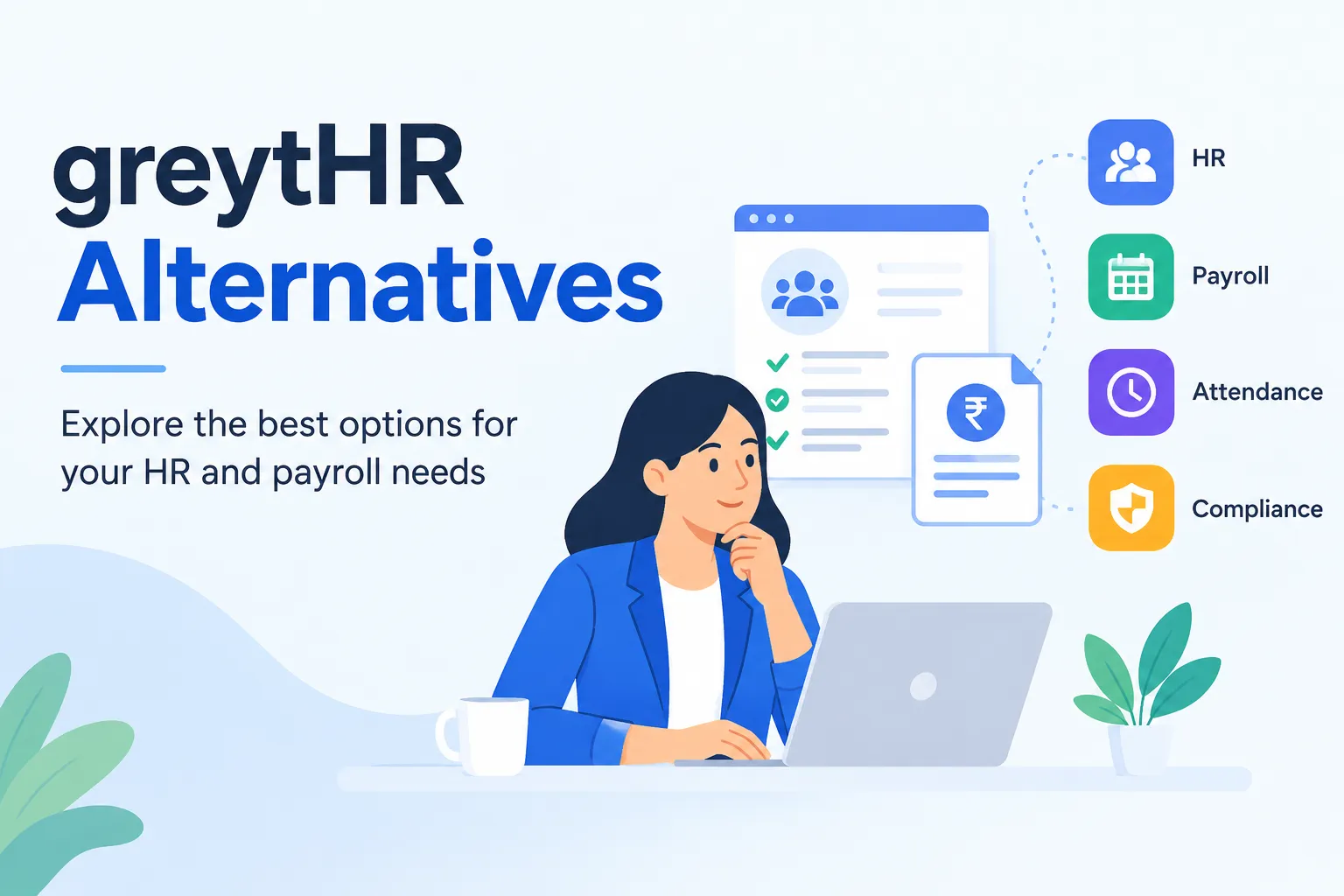
greytHR is an established HR and payroll platform used by businesses to manage employee information, attendance, leave, payroll, and related HR processes. Its employee self-service capabilities also give employees access to information such as payslips, leave, and attendance records.
If you are researching greytHR Alternatives, the reason is usually practical rather than simply wanting a different brand. Your organization may need a different combination of payroll, workforce management, attendance, integrations, scalability, or day-to-day usability.
A good greytHR competitor should fit the way your HR team actually works. Instead of comparing software only by the number of modules listed on a website, look at how well each platform handles your payroll cycle, employee records, attendance, leave, approvals, reporting, and other processes that matter to your business.
Why Consider greytHR Alternatives?
greytHR offers a range of HR and payroll capabilities, but every organization has its own processes and workforce needs. That is why it makes sense to compare different platforms and choose one that aligns with your team's day-to-day requirements.
Different payroll and HR requirements: Some businesses need a focused payroll and HR setup, while others want a wider workforce platform with additional employee lifecycle or operational capabilities.
Broader workforce management: Organizations with field teams, shift-based employees, or employees spread across locations may place greater importance on attendance, workforce visibility, shift handling, and mobile workflows.
Multi-location operations: If HR processes run across several offices, sites, branches, or facilities, centralized employee and attendance data can become an important selection factor.
Integration requirements: Your payroll platform may need to work with accounting systems, attendance devices, finance tools, or other business applications. Checking integration options before selecting software can prevent unnecessary manual work later.
Ease of use and implementation: A feature-rich platform still needs to be practical for HR administrators, managers, and employees. Consider how easily your team can adopt the system and complete routine tasks.
Pricing and scalability: Compare the total cost against your current workforce size and expected growth. The right platform should make sense not only today but also as your employee count and HR processes change.
1. Firmity
Firmity takes a broader approach to workforce management by connecting employee management and payroll with facility operations. Its platform brings employee records, attendance, leave, tasks, payroll, and other operational processes into one environment.
For organizations managing employees across facilities or multiple properties, this can be useful because workforce information does not have to sit separately from day-to-day facility operations. Firmity's employee management module supports centralized employee records, digital attendance, leave management, workforce reporting, and field visibility.
Firmity's payroll platform also connects attendance and leave information with payroll processing. This can reduce the need to reconcile the same employee data across separate systems.
Key capabilities include employee records, digital attendance, leave workflows, workforce and multi-site visibility, attendance-linked payroll, payroll reporting, employee self-service, and broader facility management modules.
Best suited for: Organizations that need HR and payroll capabilities alongside facility and workforce operations, particularly businesses managing employees across multiple sites or properties.
Explore Firmity's Payroll Software or contact Firmity for a product discussion.
2. Keka
Keka is an HR and payroll platform that brings employee management, attendance, leave, payroll, and other people processes together. Its platform connects payroll with attendance and leave inputs, which can help HR teams reduce repetitive data handling during payroll processing.
Attendance features include time tracking, shift management, leave management, and support for different work arrangements. Keka also provides payroll capabilities covering areas such as statutory deductions and employee tax-related processes.
The platform is worth considering when your priority is a dedicated HR system with payroll and workforce-related features rather than a facility management platform.
Key capabilities include HR and employee information management, attendance and leave management, shift and overtime management, payroll automation, employee self-service, and performance-related HR workflows.
Best suited for: Growing organizations looking for a dedicated HR and payroll platform with connected employee and workforce processes.
3. Zoho People
Zoho People is an HR platform within the wider Zoho ecosystem. It provides tools for employee records, attendance, shifts, leave, self-service, workflows, and other HR activities.
Businesses can manage employee information from a centralized system and configure attendance using web, mobile, location-based restrictions, and supported biometric integrations. Its leave and shift capabilities can also be configured around organizational policies.
One advantage to consider is the broader Zoho ecosystem. If your organization already uses other Zoho applications, the ability to connect HR processes with the wider business software environment may be relevant when comparing alternatives.
Key capabilities include centralized employee records, attendance and check-in/check-out, leave and time-off management, shift management, employee self-service, and workflow automation.
Best suited for: Businesses looking for HR software that can work alongside other applications in the Zoho ecosystem.
4. Pocket HRMS
Pocket HRMS focuses on HR, payroll, attendance, leave, and employee self-service through a connected HRMS platform. Its payroll capabilities include configurable salary structures and statutory compliance features, while its attendance tools support multiple ways of capturing employee attendance.
The platform also provides mobile and self-service options, which can be useful for organizations where employees and managers need to complete HR tasks without depending on the HR team for every request.
Pocket HRMS can make sense for businesses looking for a dedicated HRMS that combines payroll with attendance, leave, employee services, and related HR functions.
Key capabilities include payroll processing, salary management, attendance and shift management, leave management, employee self-service, mobile HR workflows, and payroll compliance features.
Best suited for: Organizations looking for an integrated HR and payroll system with employee self-service and configurable workforce processes.
5. factoHR
factoHR provides an HR platform covering employee management, attendance, leave, payroll, recruitment, performance, expenses, and employee self-service. Its payroll system connects salary information with attendance and leave data, helping HR teams keep payroll inputs in one place.
For businesses with distributed teams, attendance capabilities include options such as mobile attendance, geolocation, geofencing, and integrations with attendance sources. The platform also supports payroll compliance processes and reporting.
factoHR is worth considering when the goal is to manage a broad range of HR processes from one platform rather than use separate tools for payroll, attendance, and employee records.
Key capabilities include core HR, attendance and leave management, payroll and statutory compliance, employee self-service, recruitment and onboarding, performance, and expense management.
Best suited for: Businesses looking for a dedicated HRMS that combines payroll, attendance, employee lifecycle management, and other HR processes.
6. HROne
HROne is a human capital management platform with modules covering core HR, payroll, attendance, leave, performance, recruitment, workforce management, expenses, and other employee-related processes.
Its attendance system supports configurable leave policies, check-in, overtime, compensatory off, shifts, and other time-related processes. Its payroll offering is positioned as part of the wider HCM platform, allowing organizations to connect payroll with other HR activities.
HROne may be a useful alternative for organizations that want a broader HCM environment rather than a payroll-only solution.
Key capabilities include core HR and employee lifecycle management, payroll management, attendance and leave, shift and overtime processes, recruitment and performance management, and workforce and expense management.
Best suited for: Organizations looking for a broader HCM platform with payroll, workforce, and employee lifecycle capabilities.
7. PeopleStrong
PeopleStrong offers a broad human capital management platform covering core HR, payroll, leave and attendance, recruitment, onboarding, performance, learning, career and skills, and other workforce processes.
Its payroll and workforce management capabilities connect payroll with attendance and leave data, while employee self-service is available for payroll-related information and other HR activities. The platform is positioned for organizations ranging from growing businesses to large enterprises.
PeopleStrong can be a strong consideration when your HR requirements extend beyond payroll and attendance into wider workforce, talent, and employee experience processes.
Key capabilities include core HR and employee lifecycle management, payroll and workforce management, leave and attendance, recruitment and onboarding, performance and talent processes, and employee self-service.
Best suited for: Larger or growing organizations looking for a broad HCM platform that can support payroll, workforce management, and wider people processes.
How to Choose the Right greytHR Alternative?
Once you have shortlisted a few options, compare them against your actual HR workflow. A simple checklist can help you avoid choosing software based only on a long feature list.
Identify your core HR and payroll requirements: Start with the processes your team handles every month. List employee records, attendance, leave, salary processing, compliance, approvals, reports, and any other essential workflows.
Check attendance and leave capabilities: If payroll depends on attendance, shifts, overtime, or leave, make sure the software can handle those inputs in a way that fits your policies.
Review payroll and compliance features: Check salary structures, statutory deductions, payroll reports, approvals, and required records. For India-focused payroll, verify current statutory requirements with official sources such as the Employees' Provident Fund Organisation (EPFO).
Consider integrations: Look at the systems your HR and finance teams already use. Attendance devices, accounting software, banking processes, ERP platforms, and other integrations can affect how much manual work remains after implementation.
Evaluate scalability: Think beyond the current employee count. If you are adding branches, facilities, departments, or different employee categories, make sure the platform can support the added complexity.
Compare implementation and overall cost: Consider more than the subscription price. Implementation effort, data migration, training, integrations, support, and additional modules can all affect the overall investment.
Consider support and usability: HR software becomes part of everyday work. A platform that employees and managers can use comfortably is more valuable than one that looks impressive but creates friction in routine tasks.
If payroll is the main priority, you can also review Firmity's best payroll management software guide and compare the capabilities that matter most to your organization.
Final Thoughts
The best greytHR alternative depends on what you want to improve. Some organizations may prioritize dedicated HR and payroll workflows, while others may need broader workforce management, stronger multi-location support, or connections with other business operations.
Firmity stands out for organizations that want to connect employee management and payroll with facility operations. Keka, Zoho People, Pocket HRMS, factoHR, HROne, and PeopleStrong each offer different approaches to HR, payroll, attendance, and workforce management.
Before making a decision, shortlist the platforms that match your actual processes and then compare them using real payroll, attendance, leave, reporting, and employee-management requirements. A focused comparison will give you a much clearer answer than choosing based on feature count alone.
Author Bio

Syed Aadam
Syed Aadam is a software engineer with a Bachelor's and Master's in Information Technology with a specialization in Artificial Intelligence and Machine Learning. Having trained, and assisted in training foundational ML models for solving frontier scientific problems at the intersection of biodiversity and technology, Syed Aadam has been working to develop AI-enabled CMMS, ERP and CAFM softwares at Ufirm Technologies.
Talk to our team
Questions about facility management software? Leave your details and we'll get back to you within 24 hours.
More on Payroll Management
Zoho Payroll Alternatives: 7 Best Payroll Software Options to Consider
Compare Zoho Payroll alternatives for payroll processing, compliance, attendance integration, employee self-service, and growing business needs.
Keka Alternatives in India: Best Payroll Software Options to Consider
Explore Keka alternatives in India, including Firmity, greytHR, and Zoho Payroll. Compare payroll features, workforce management, and business needs to find the right Payroll Software for your organization.
Best Payroll Management Software in India: Top Payroll Software
best payroll management software in India, compare top payroll platforms, key features, benefits, and selection tips to find the right solution for your business.