Guide
Predictive Maintenance for Renewable Energy Assets
A Smarter Approach to Maximizing Performance
· 5 min read
What You'll Learn in This Article
In this guide, you'll discover how predictive maintenance is transforming renewable energy operations across the Gulf. We'll explore why traditional maintenance strategies are no longer sufficient for modern solar and wind farms, how technologies such as AI and IoT enable maintenance teams to detect failures before they happen, and how organizations can reduce downtime, lower operating costs, and extend the life of critical assets. You'll also learn why integrating predictive maintenance with a CMMS is becoming essential for renewable energy operators looking to maximize asset performance.
Unlike conventional power plants, renewable energy assets are often spread across vast desert landscapes and operate under harsh environmental conditions. High temperatures, sandstorms, dust accumulation, humidity, and remote locations make maintenance significantly more challenging.
Renewable Energy Is Growing Rapidly Across the Gulf
Over the past decade, the Gulf region has become one of the world's fastest-growing renewable energy markets. Countries such as the UAE, Saudi Arabia, Oman, and Qatar are investing billions of dollars into utility-scale solar parks, wind farms, and battery energy storage systems as part of their long-term sustainability strategies. Projects like Mohammed bin Rashid Al Maktoum Solar Park in Dubai and NEOM's renewable energy initiatives are reshaping the region's energy landscape.
As these facilities continue to expand, so does the challenge of maintaining thousands of critical assets spread across vast and often remote locations. Solar panels, inverters, transformers, wind turbines, batteries, and electrical infrastructure must operate continuously despite extreme temperatures, sandstorms, dust accumulation, and humidity. Even a single equipment failure can significantly reduce power generation, increase maintenance costs, and impact contractual energy commitments.
For this reason, many renewable energy operators are moving beyond reactive and scheduled maintenance towards predictive maintenance—a strategy that helps identify potential failures before they occur.
What Is Predictive Maintenance?
Predictive maintenance is a proactive maintenance strategy that uses real-time equipment data to determine when maintenance should be performed. Instead of replacing components based solely on fixed schedules, predictive maintenance continuously evaluates the health of equipment using sensors, operational data, and intelligent analytics.
When a motor begins vibrating more than usual or an inverter starts operating at abnormal temperatures, the system identifies these changes as early warning signs. Maintenance teams receive alerts before the issue develops into a costly failure, allowing repairs to be planned during scheduled maintenance windows rather than emergency shutdowns.
This approach allows organizations to maintain equipment only when necessary while significantly reducing unexpected breakdowns.
Predictive maintenance helps maintenance teams detect abnormal vibration, temperature changes, electrical faults, or declining performance long before equipment fails completely.
Common Challenges in the Gulf Region
Renewable energy operators across the Middle East face unique environmental conditions that accelerate equipment wear.
Fine desert dust reduces solar panel efficiency and can clog cooling systems.
Extreme summer temperatures place additional stress on electrical equipment and battery storage.
Remote project locations make emergency repairs expensive and time-consuming.
Large utility-scale installations often span hundreds of hectares, making manual inspections difficult.
Predictive maintenance allows operators to monitor assets remotely and dispatch maintenance teams only when data indicates intervention is required.
How Predictive Maintenance Works
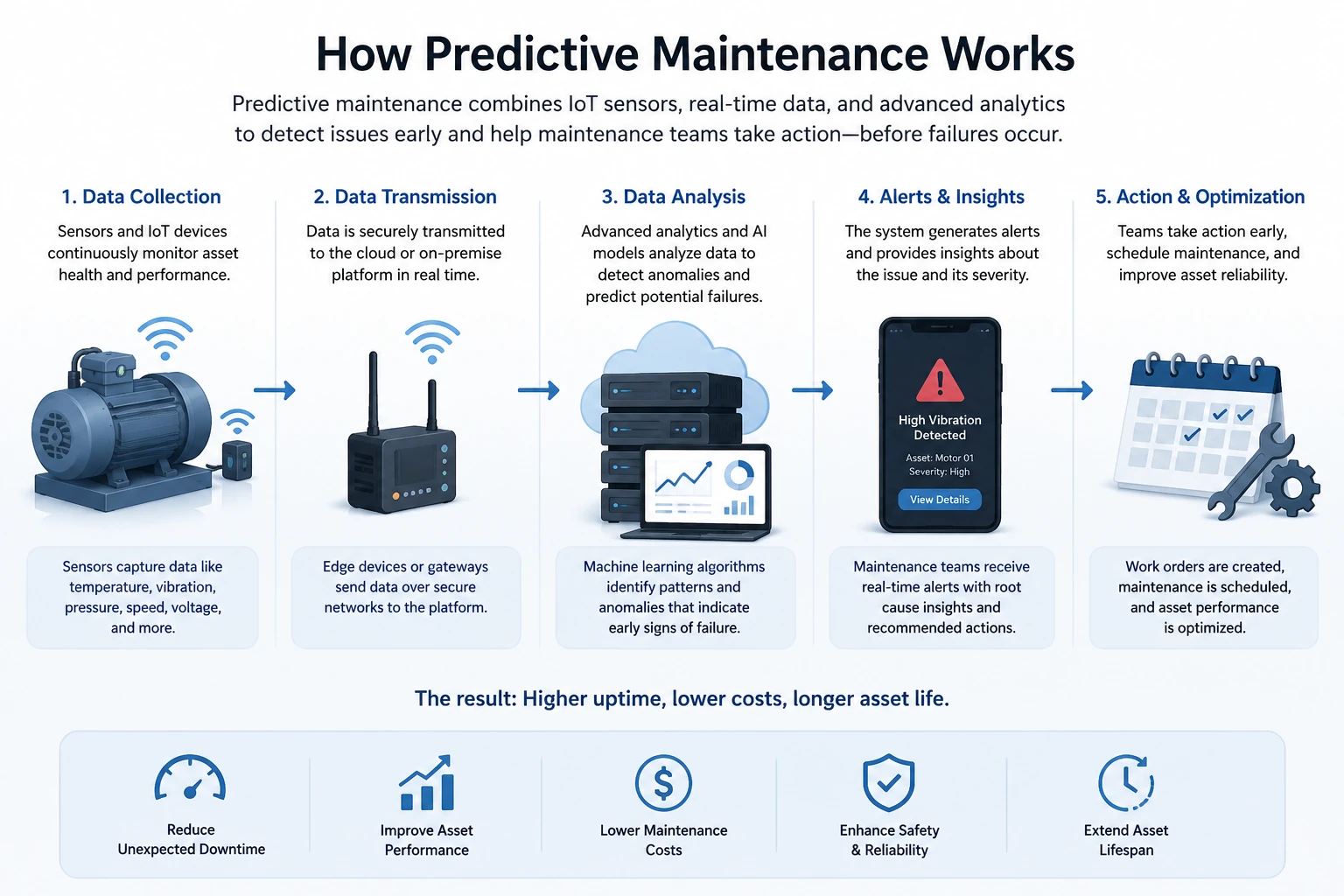
Modern predictive maintenance combines IoT sensors, cloud computing, artificial intelligence, and maintenance management software into a single connected ecosystem. Sensors installed on equipment continuously collect information such as temperature, vibration, voltage, electrical current, operating hours, humidity, and pressure. This data is transmitted to cloud platforms where machine learning models compare current operating conditions against historical performance.
When the system detects abnormal behaviour, it automatically generates alerts for maintenance teams. Instead of relying on routine inspections or waiting for equipment to fail, technicians receive precise information about which asset requires attention, the likely cause of the issue, and the recommended maintenance action. Work orders can then be created automatically within a CMMS, allowing maintenance managers to schedule repairs before production is affected.
The result is a maintenance process that is driven by equipment health rather than calendar dates, improving both operational efficiency and asset reliability.
Why Predictive Maintenance Matters for Renewable Energy
Renewable energy facilities rely on thousands of interconnected components working together to produce electricity. A failing inverter can reduce the output of an entire solar array, while a damaged gearbox can force an entire wind turbine offline. Because many renewable energy sites are located in remote areas, emergency repairs often involve significant travel, specialist equipment, and extended downtime.
Predictive maintenance helps operators avoid these situations by identifying equipment deterioration early. Instead of discovering problems during routine inspections or after failures occur, maintenance teams can intervene while equipment is still operational. This reduces downtime, minimizes repair costs, improves energy generation, and extends the lifespan of valuable assets.
For organizations managing hundreds or even thousands of renewable energy assets, these improvements translate into substantial long-term financial savings.The Role of CMMS Software
A Computerized Maintenance Management System (CMMS) becomes the operational hub for predictive maintenance.
Sensor alerts can automatically generate work orders.
Technicians can access maintenance history directly from mobile devices.
Inspection reports, warranties, manuals, and asset documentation remain centralized.
Maintenance managers can track KPIs such as MTTR, MTBF, asset availability, maintenance costs, and technician productivity from a single dashboard.
By combining predictive analytics with CMMS software, organizations transform maintenance data into actionable decisions instead of isolated alerts.
Renewable Energy Assets That Benefit Most
Predictive maintenance is particularly valuable for high-value and mission-critical equipment, including:
Solar PV inverters
Wind turbine gearboxes
Wind turbine blades
Transformers
Battery energy storage systems (BESS)
Cooling systems
High-voltage switchgear
Grid interconnection equipment
Monitoring these assets continuously helps operators avoid costly outages while maximizing energy generation.
The Role of CMMS Software
While sensors and AI provide valuable insights, they become significantly more effective when integrated with a Computerized Maintenance Management System (CMMS). A CMMS acts as the operational backbone of predictive maintenance by converting equipment alerts into structured maintenance workflows.
When an abnormal condition is detected, work orders can be generated automatically, technicians can access maintenance history through mobile devices, and managers can monitor key performance indicators such as MTTR, MTBF, equipment availability, and maintenance costs from a centralized dashboard. Rather than managing maintenance through spreadsheets or manual reporting, organizations gain complete visibility into asset performance and maintenance activities.
This integration enables faster decision-making while ensuring maintenance records remain accurate and easily accessible throughout the asset lifecycle.
Best Practices for Successful Implementation
Successful predictive maintenance programs begin with critical assets rather than attempting to monitor every piece of equipment.
Organizations should install reliable sensors, maintain accurate asset records, integrate operational data into their CMMS, and continuously review maintenance KPIs.
Maintenance teams also need proper training to interpret equipment health data and prioritize maintenance activities based on business risk rather than routine schedules.
As more operational data becomes available, predictive models become increasingly accurate over time.
Looking Ahead
As renewable energy infrastructure continues to grow across the Gulf, maintenance strategies must evolve alongside it. Artificial intelligence, digital twins, drones, thermal imaging, and autonomous inspections are already transforming how operators monitor and maintain critical assets. Predictive maintenance sits at the centre of this transformation, enabling organizations to move from reactive repairs to data-driven maintenance planning.
For renewable energy operators across the Middle East, adopting predictive maintenance is no longer simply a technological upgrade—it is becoming a business necessity. Organizations that invest in intelligent maintenance today will be better positioned to maximize energy production, reduce operational costs, improve equipment reliability, and support the region's ambitious clean energy goals for decades to come.
Talk to our team
Questions about facility management software? Leave your details and we'll get back to you within 24 hours.
More on Guide
CAFM vs CMMS: What’s the Difference?
CAFM vs CMMS explained: Learn the key differences, features, use cases, benefits, and how to choose the right system for facility and maintenance management.

Monsoon Readiness Checklist for Facility Managers in India
The rains expose every gap in a facility's maintenance plan. Here's how to close them before the first downpour.

A New Chapter: Firmity Expands to Hyderabad
Closer Partnerships, Better Service