Inventory Management
Inventory Accuracy: What It Is and How Inventory Software Improves It
· 8 min read
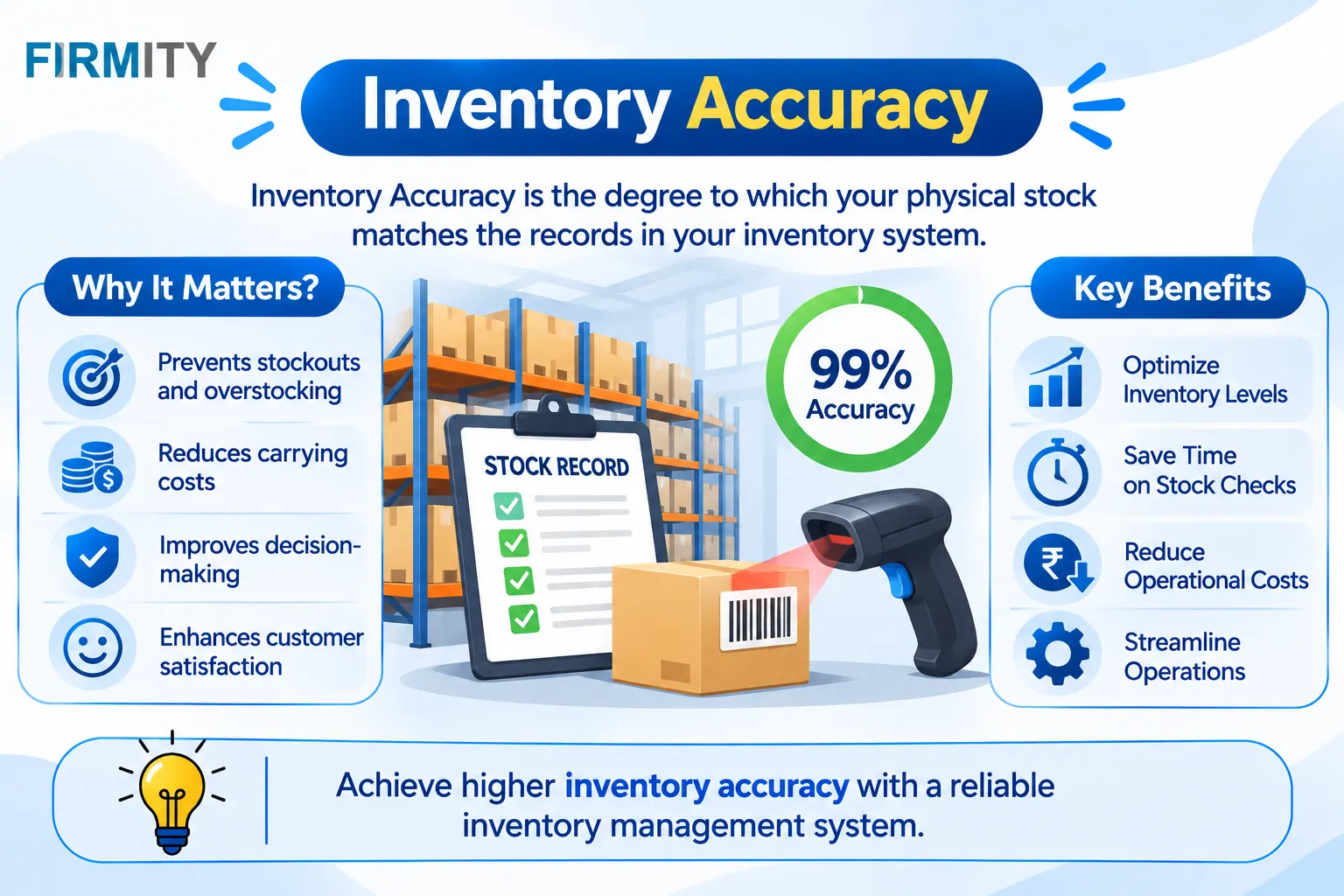
Inventory accuracy is how closely your stock records match what's actually on the shelf, and software improves it by recording every movement as it happens. When the two line up, you can trust your numbers, and when they don't, every decision built on them gets shaky.
That trust is the quiet foundation of inventory management software, because the whole point of the system is to be a record you can rely on. In this guide, we'll cover what accuracy means, how to calculate it, why it slips and how to bring it back. It's written in plain language and works for any business, whatever you stock.
A quick note on how this was put together. We looked at how sources such as Megaventory, DCL and Cleverence explain inventory accuracy, and noticed that they quote different targets and often focus on warehouses and online stores. So we've kept to the basics that apply everywhere. Firmity is our product, so it gets one short, clearly labeled mention near the end.
What Is Inventory Accuracy?
Inventory accuracy is the match between what your system says you have and what you physically hold. If the records say there are ten of an item and there are ten on the shelf, that record is accurate. If there are seven, it isn't, and the gap is a problem waiting to happen. It can apply to quantity, but also to the right item and the right location.
It's worth noticing that accuracy isn't about perfection on every single item. It's about whether your records are close enough to reality that you can make sound decisions. A shelf that's off by one low-value item matters far less than a high-value part that's missing. That's why many teams look at accuracy both by number of items and by value.
How to Calculate Inventory Accuracy
The formula is simple. Divide the units you counted by the units your records say you have, then multiply by 100 to get a percentage. Teams sometimes count the number of item records that are correct instead, which works the same way. Here's a quick example, made up purely for illustration.
Say your system shows 200 units of an item, and a physical count finds 190. That's 190 divided by 200, times 100, which gives 95%. The same approach works for a whole storeroom: add up the counts and the recorded quantities, then compare. Remember that the way you measure, by item count or by value, changes the result, so pick one and stay consistent.
Why Inventory Accuracy Matters
When records are accurate, you stop being surprised. You know when to reorder, so you avoid running out of something you needed. You also avoid buying things you already have, which keeps cash from getting tied up in stock that sits unused. Counts become quick checks instead of lengthy rescue missions.
There's a trust element too. When people believe the numbers, they use the system, and when they don't, they build their own side lists. Accurate records also support the wider benefits of inventory management software, from smoother purchasing to cleaner audits. Over time, accuracy compounds, because good data leads to better decisions.
Common Causes of Inaccurate Inventory
Most inaccuracy comes from ordinary, avoidable things. Understanding them is half the battle, since each one has a fix. Here are the usual suspects:
Manual entry errors: a typo, a missed line or a number entered twice.
Unrecorded movements: items taken or moved without anyone updating the system.
Receiving mistakes: goods booked in at the wrong quantity or against the wrong item.
Returns and damage: items that come back or get broken without a record.
Loss and theft: stock that disappears without being noticed.
Messy item data: duplicate items, unclear names or inconsistent units.
Notice that most of these come down to people and process, not software. That's good news, because they can be fixed with clearer habits and better tools. The goal isn't to blame anyone, it's to make the right action the easy action.
How Inventory Management Software Improves Accuracy
Software helps by making records update as things happen. With real-time stock tracking, every receipt, issue and transfer adjusts the balance straight away, so records don't drift between counts. Purchase orders and goods receipts can be matched, so what arrives is checked against what was ordered. Each movement also carries a name and a time, which makes mistakes easier to trace.
Scanning can help even more. A barcode inventory system replaces typing with scanning, which removes a major source of manual errors. Permissions control who can adjust stock, and an audit trail shows what changed. None of this makes mistakes impossible, but it makes them rarer and easier to spot.
Want to See How Accuracy Would Improve With Your Own Stock?
It's easier to judge accuracy tools when you can see your own items in them. If your records and shelves often disagree, you can book a free demo and see how Firmity records receipts, issues and approvals using your own item list. Tell the team what you're tracking today, and they'll reply within 24 hours.
Cycle Counting: A Simple Habit That Keeps Records Honest
Cycle counting means counting a small part of your stock on a regular schedule instead of everything at once. You might count one shelf or one category each week, so the whole storeroom gets checked over a few months. When you find a difference, you investigate, correct the record and note the cause. Over time, you build a clear picture of where mistakes come from.
The advantage over a single big annual count is that problems get caught early. Records stay closer to reality, and you don't need to shut things down for days. It also gives you a steady stream of information about your process, which is more useful than a single yearly surprise. Many teams find that a short weekly count does more for accuracy than a long annual one.
A Simple Improvement Plan
Step | What to do | Sign it's working |
|---|---|---|
Measure | Count a sample and work out your accuracy rate | You have a starting number to improve on |
Clean data | Merge duplicate items and tidy up names and units | Each item appears once with a clear name |
Record movements | Log every receipt, issue and transfer as it happens | Balances move when stock moves |
Scan | Use codes and scanners instead of typing | Fewer typing errors show up |
Count in cycles | Count a small area on a regular schedule | Differences are found and fixed early |
Review causes | Look at why differences happen | Repeat errors become less frequent |
Metrics to Track
You don't need a dashboard full of numbers to improve accuracy. A few simple ones are enough. Track your accuracy rate over time, so you can see whether it's improving. Keep an eye on the number of stock adjustments you make, since a falling number usually means fewer mistakes. And note how many cycle counts match the records on the first try.
Value matters too, because a missing high-value item hurts more than a missing low-value one. The international standard for inventories, IAS 2, requires inventories to be measured at the lower of cost and net realizable value, which is one reason accurate quantities feed straight into your accounts. Accounting rules differ by country, so check what applies to you. We haven't set a target rate here, since the right goal depends on your business and how you measure.
Where Firmity Fits In
Since we've covered accuracy, here's a short, honest mention. Firmity's inventory software is an affordable option for teams that want strong stock control without paying for a full ERP, and the team can quote for your setup. It keeps stock, spare parts, purchase orders, vendor rate cards, goods receipts and a stock ledger in one cloud platform, so movements are recorded in one place. Purchase approvals leave a timestamped record you can export, and stock reports can cover several locations. Its public pages don't spell out barcode scanning or cycle-count tools, so ask about those and about regional needs during a demo.
Common Mistakes When Trying to Improve Accuracy
The most common mistake is only counting once a year. By then, errors have piled up and nobody remembers where they came from. The second is fixing the numbers without finding the cause, which means the same mistake returns next month. And the third is skipping training, since people can't follow a process they haven't been shown.
Final Thoughts
Inventory accuracy isn't about perfection, it's about records you can trust. Measure where you are, record movements as they happen, count in small cycles and fix causes instead of numbers. If you'd like to see how this would work with your own items, you can book a free demo with the Firmity team.
FAQs : What is inventory accuracy
It's how closely your recorded stock matches the stock you physically have. When the two agree, you can trust your records.
Divide the units you counted by the units on record and multiply by 100. For example, counting 190 units against 200 on record gives 95%.
There's no single answer, because it depends on your business, what you stock and how you measure it. A useful goal is to set a target with your team and improve steadily.
Yes, because it records movements as they happen, matches receipts to orders and keeps a trail of changes. It reduces errors, though good habits and regular counts still matter.
Author Bio

Syed Aadam
Syed Aadam is a software engineer with a Bachelor's and Master's in Information Technology with a specialization in Artificial Intelligence and Machine Learning. Having trained, and assisted in training foundational ML models for solving frontier scientific problems at the intersection of biodiversity and technology, Syed Aadam has been working to develop AI-enabled CMMS, ERP and CAFM softwares at Ufirm Technologies.