Inventory Management
7 Best QuickBooks Alternatives in 2026 (Compared by Business Need)
· 9 min read
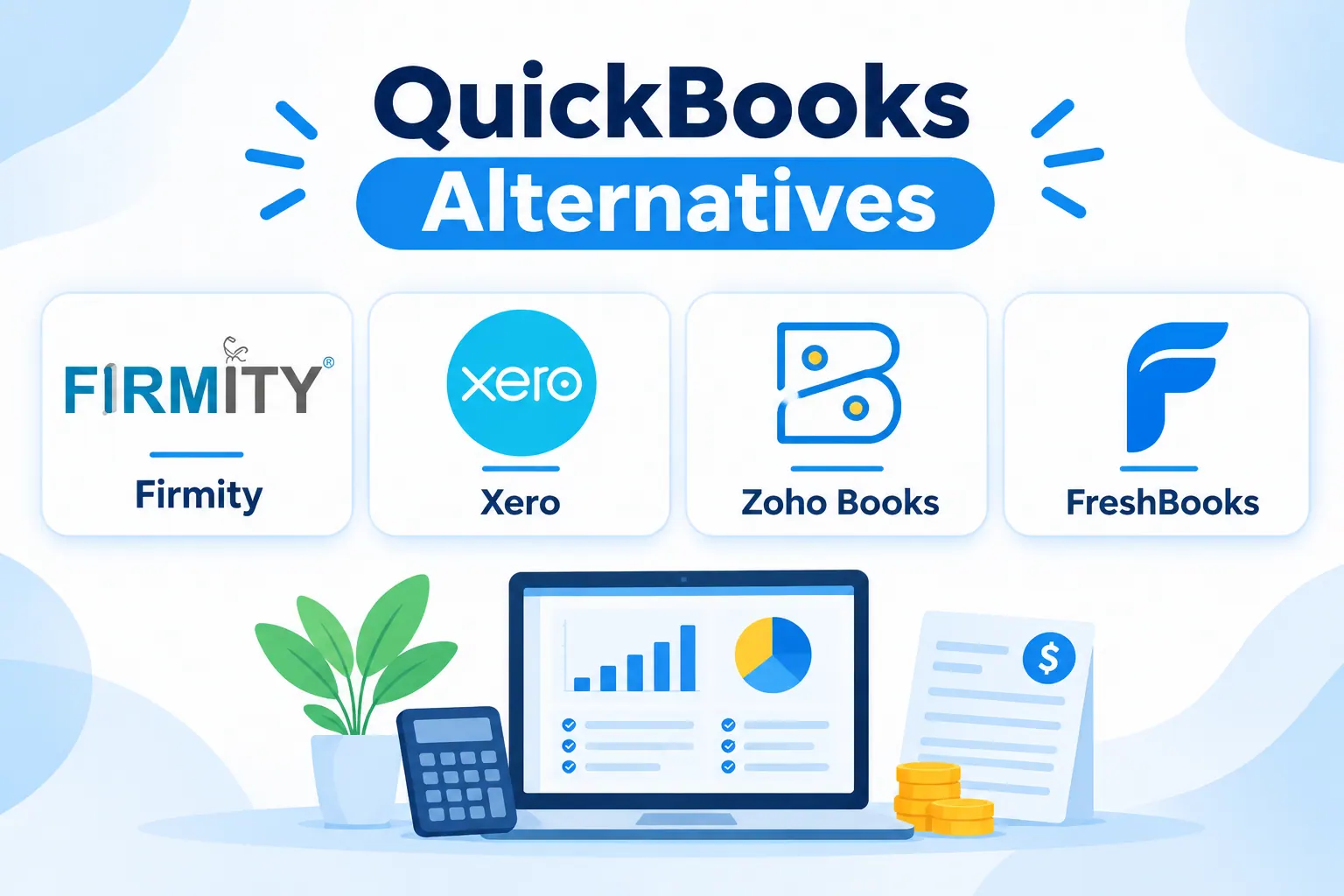
The best QuickBooks alternatives are Firmity, Xero, Zoho Books, FreshBooks, Wave, Sage and NetSuite. Which one fits depends on why you want to leave QuickBooks.
Quick disclosure: Firmity is our own product, and we’ve listed it first because it covers a different part of the problem. It handles the operations side, like expenses, purchasing and payroll, rather than replacing your general ledger. The other six are accounting tools. We’ve kept the trade-offs in for every tool, ours included, so you can decide with the full picture.
Why do people start looking for QuickBooks alternatives?
QuickBooks is a well-known accounting tool, so it’s rarely a case of it being bad. More often something about the fit changes. QuickBooks Online is sold in tiered plans with caps on users, and extras like payroll are priced on top. Intuit also changes plans and promotions fairly often, so it’s worth checking the QuickBooks pricing page for what’s current before you compare anything. For a growing team, those caps and add-ons are the usual starting point for a search.
The other common reasons are features, scale and location. Some teams need deeper inventory or project tracking, others outgrow basic accounting and want a full ERP, and some find that QuickBooks isn’t offered the same way in their country. None of this means you must switch. It just means the best tool depends on what’s bothering you most, which is why this list is organised by need and not by a single ranking.
How did we compare them?
We asked the same questions of every tool. Can it handle invoicing and bank reconciliation? How good are the reports? What happens with payroll, purchasing and inventory? How does it connect to other tools, and how is it priced? We also noted where availability depends on your country, because that matters more than most comparison sites admit.
Everything here comes from each vendor’s own pages and public reviews, checked in November 2026. We haven’t run hands-on trials, so think of this as a researched shortlist, not a lab test. We’ve left out prices on purpose, because plans and promotions change often and sites disagree. Check each vendor’s pricing page before you decide.
The 7 alternatives at a glance
Short on time? Here’s the quick comparison before we dig into each tool. Firmity sits at the top because it works alongside an accounting tool, while the rest are accounting alternatives.
Tool | Best for | Standout strength | Watch out for |
|---|---|---|---|
Firmity | Facility and operations teams | Expense approvals, purchasing and payroll workflows that post to your ledger | It works alongside your ledger, not in place of it |
Xero | Small and growing businesses wanting an all-round tool | Strong bank matching and handling of several currencies | Add-ons such as payroll vary by country |
Zoho Books | Teams already using Zoho | Connects neatly with other Zoho apps | Most useful when your other tools are Zoho too |
FreshBooks | Service businesses | Invoicing and time tracking | Fewer inventory and advanced accounting tools |
Wave | Freelancers and micro-businesses | Free core accounting and invoicing | Payment fees and country availability |
Sage | Inventory-heavy or mid-sized businesses | Deeper inventory and job costing, plus mid-market depth | Which products you can buy depends on your country |
NetSuite | Larger, more complex companies | Full ERP with multi-user depth | Pricing comes by quote, and setup takes more effort |
The 7 best QuickBooks alternatives in 2026
1. Firmity: best for facility and operations teams
Firmity is a cloud-based facility management platform that brings CMMS and ERP software together. The finance-adjacent modules are the ones that matter here. Its expense module has policy-driven budget caps and maker-checker approvals, with audit-ready journals posted to your ledger. Its inventory and vendor module generates purchase orders and tracks goods receipts, and its payroll module runs payroll with maker-checker validation and bank file generation. There are Android and iOS apps too.
Here’s where it fits. If your team uses QuickBooks mainly to chase expense approvals, purchase orders and payroll across several sites, Firmity gives those jobs a home built for facility work, and it’s used by hotels, hospitals, universities, and manufacturers. inventory software covers item catalogues, minimum stock levels, vendor rate cards, stock ledgers and transfers across properties. One note: its payroll deductions are built around India’s statutory rules, so check fit for your country.
The honest trade-off: Firmity posts journals to your ledger, so it isn’t a general-ledger replacement, and most teams would keep an accounting tool alongside it. It’s also an affordable option, which helps if you’re trying to cut software spend. To see how it would handle your own workflow, get in touch through the contact page, and the team says it replies within 24 hours.
Best for: facility, property and multi-site teams that want expenses, purchasing and payroll workflows next to their maintenance work.
2. Xero: best all-round accounting alternative
Xero is a cloud accounting tool that many reviewers treat as the closest all-round alternative to QuickBooks. It’s popular with accountants and small businesses, and it’s known for strong bank reconciliation, multi-currency support and clean financial reporting. It has also been widely noted for not charging per user, though you should confirm that on its current pricing page, since plans change.
The flip side is that add-ons aren’t identical everywhere. Payroll and some other extras are offered differently from one country to the next, so check what’s available where you operate.
Best for: small and growing businesses that want a full accounting tool with room for more users.
3. Zoho Books: best for teams already in Zoho
Zoho Books is the accounting app in the Zoho suite, and it shines when you already use other Zoho tools. It covers the accounting basics, with automation and a free plan for qualifying small businesses, so it’s a handy option if you’re watching costs. Because it connects neatly to the wider suite, it can bring sales, inventory and accounting closer together.
The catch is that it’s at its best inside the Zoho ecosystem. If you rely on lots of outside tools, check how well they connect before you commit. Also check plan limits on users and transactions.
Best for: budget-conscious teams that already run on Zoho apps.
4. FreshBooks: best for service businesses
FreshBooks was built around invoicing and client billing, and it still leans that way. It offers double-entry accounting, time tracking and a long list of integrations, which suits freelancers, agencies and other service businesses that live in invoices and billable hours. Reviewers often praise its simplicity and customer support.
Simplicity has a price, though. It’s lighter on inventory and deeper accounting than some alternatives, and extra team members may cost more, so check how users are priced.
Best for: service businesses that want clean invoicing and time tracking without a heavy accounting setup.
Running expenses, purchasing and payroll across several sites? Tell the Firmity team what you manage today, and they’ll show you which modules fit. They say they reply within 24 hours. Talk to the Firmity team.
5. Wave: best free option for micro-businesses
Wave is a popular free starting point. It offers core accounting, invoicing and receipt tracking at no cost, which makes it appealing for freelancers and very small businesses. Reviewers note that the free tools come with fees when you use its payment processing, so the savings depend on how you get paid.
Availability and payment features can differ by country, so confirm what you’d actually get where you are. It’s also built for simple needs, so teams with inventory, multiple users or complex reporting may outgrow it.
Best for: freelancers and micro-businesses with simple bookkeeping needs.
6. Sage: best for inventory-heavy or mid-sized businesses
Sage sells several products, which is both its strength and its confusion. Sage 50 is often recommended for businesses that need deeper inventory and job costing, while Sage Intacct targets mid-sized companies that want more financial depth and multi-entity features. If QuickBooks feels thin on inventory, this is a brand worth looking at.
Product names, features and availability differ by country, and Intacct is typically quote-based, so ask which product is sold in your region before you compare.
Best for: inventory-heavy businesses and mid-sized companies that need more accounting depth.
7. NetSuite: best for outgrowing accounting software
NetSuite, from Oracle, is a full ERP system, not just an accounting tool. It supports many users and permissions, and it covers areas like finance, inventory and operations in one platform. That makes it a natural step for companies that have outgrown QuickBooks and want accounting and operations in a single system.
It isn’t a light switch. Pricing is typically quote-based and implementation is more involved than moving between small-business tools, so it suits larger accounting budgets and more complex operations.
Best for: larger or fast-growing companies that need a full ERP.
How to choose based on why you’re leaving
Start with the reason you’re looking, because it points to different answers. Use this table as a quick guide, then check current plans on each vendor’s site.
If you’re leaving because of… | Look at | Why |
|---|---|---|
Cost as your team grows | Xero, Zoho Books, Wave | Their pricing models differ, so compare how each charges for users. |
Service invoicing and time tracking | FreshBooks | It’s built around billing clients and tracking hours. |
Inventory depth | Sage, or a dedicated inventory tool | Deeper stock and job costing than basic accounting plans. |
Scale and complexity | NetSuite, Sage Intacct | Built for larger, multi-user and multi-entity operations. |
Expense, purchasing and payroll workflows for facilities | Firmity, alongside your ledger | Facility-specific workflows that post journals to your accounting tool. |
If inventory is the real reason you’re looking around, our guide to the top inventory management software is a better starting point than another accounting comparison. Our guides to Zoho Inventory alternatives and Odoo Inventory alternatives cover more options if you want to compare dedicated tools.
Planning to switch? A short checklist
Switching accounting tools is easier with a plan. Here’s a short list of things to sort out before you move.
Export your data: customers, suppliers, your chart of accounts and open invoices and bills.
Map your chart of accounts: decide how old accounts line up with the new ones before you import.
Bring your accountant in: they’ll spot problems with opening balances faster than you will.
Run both systems for one period: compare the reports before you switch off the old one.
Check your connections: bank feeds, payroll, payment tools and anything else that plugs in.
The bottom line
There’s no single best QuickBooks alternative, only a best fit for your reason for leaving. Xero, Zoho Books, FreshBooks and Wave are the usual accounting picks, Sage and NetSuite suit more complex needs, and Firmity helps when the real pain is expenses, purchasing and payroll across sites. Shortlist two or three, test them on a real workflow and let your accountant weigh in before you commit.
FAQs : QuickBooks Alternatives
There isn’t one winner. Many reviews point to Xero as the best all-round accounting alternative, FreshBooks suits service businesses, and Zoho Books suits teams already in Zoho. Pick based on why you’re leaving, and check what’s available in your country.
Yes. Wave offers free core accounting and invoicing, and Zoho Books has a free plan for qualifying small businesses. Check the limits and any payment fees, and confirm availability where you operate, before you rely on either.
Most reviews call Xero the closest all-round replacement, since it covers similar ground with strong reconciliation and reporting. FreshBooks is simpler and more invoicing-led, and Zoho Books fits best inside the Zoho suite.
Not as a general ledger. Firmity covers expense approvals, purchasing and payroll workflows for facility teams, and it posts journals to your ledger, so most teams use it alongside an accounting tool. If you only need bookkeeping and invoicing, choose from the other six.
Author Bio

Syed Aadam
Syed Aadam is a software engineer with a Bachelor's and Master's in Information Technology with a specialization in Artificial Intelligence and Machine Learning. Having trained, and assisted in training foundational ML models for solving frontier scientific problems at the intersection of biodiversity and technology, Syed Aadam has been working to develop AI-enabled CMMS, ERP and CAFM softwares at Ufirm Technologies.