Payroll Management
What Is Payroll? Meaning, Process and Components (Explained for Indian Businesses)
· 8 min read
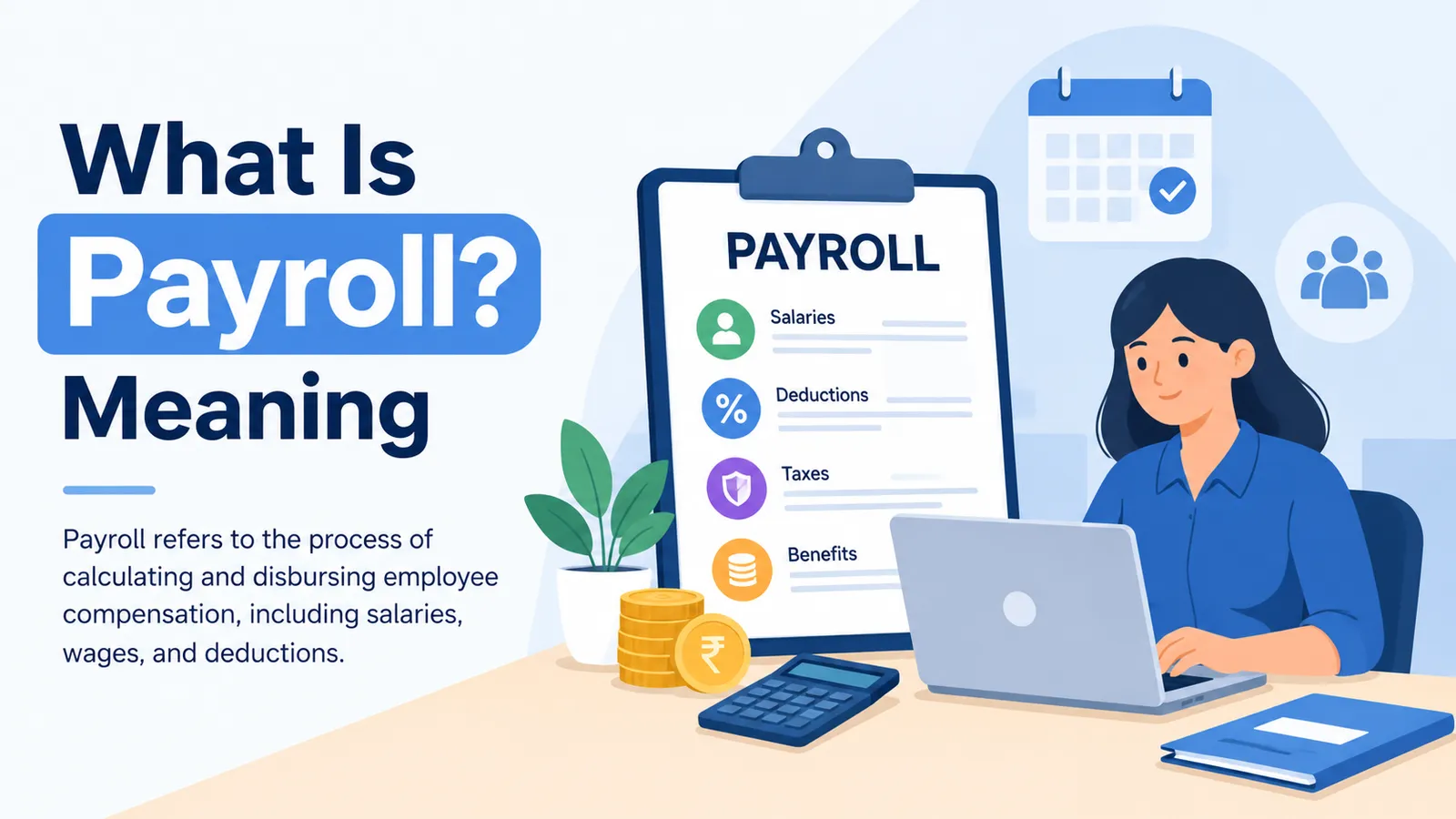
What is payroll? In simple words, it's the process of paying your employees, plus all the work that goes around it.
That includes working out salaries, taking off deductions, paying staff on time and keeping proper records.
If you've just hired your first employee, or you're taking over HR, this guide is for you. We'll keep things simple and focus on how payroll works in India. Let's dive in.
What is payroll?
Payroll is the way a business pays its employees. It covers calculating pay, deducting taxes and other contributions, making the payment and recording everything.
The word gets used in a few ways. It can mean the process itself. It can also mean the list of people you pay, or the total amount of money paid to them.
So if someone says, "our payroll is going up," they usually mean the total cost of salaries.
Why payroll matters
Payroll feels like admin. It's actually one of the most important things a business does.
Here's why:
People get paid correctly and on time. Nothing damages trust faster than a wrong salary.
Deductions are handled properly. Taxes and contributions have to reach the right place.
Compliance stays on track. Missed filings can lead to penalties.
Records are ready when you need them. That makes audits far less stressful.
It's a big cost. For many small businesses, payroll is one of the largest expenses.
So getting it right isn't optional. It affects your team, your cash flow and your legal standing.
Key components of payroll
A payslip can look busy. But it's built from just a few parts.
Component | What it means | Simple example |
|---|---|---|
Gross pay | What the employee earns before any deductions | Monthly salary plus allowances |
Deductions | Amounts taken off, such as taxes and contributions | PF, ESI, professional tax, TDS |
Net pay | What actually reaches the employee's bank account | Gross pay minus deductions |
Payslip | A document that lists what you earned, what was deducted and what you take home. | The monthly slip employees receive |
Records | Your proof that payroll was done correctly | Payslips, attendance logs, challans |
Here's a quick illustration. This isn't a real calculation, it just shows the idea.
Suppose an employee’s gross pay is ₹40,000 for the month. . Deductions add up to ₹6,000. Their net pay is ₹34,000.
Easy enough, right? The tricky bit is working out what those deductions should be.
How payroll works, step by step
Most payroll cycles follow the same path every month.
1. Collect attendance and leave data. You can't pay people correctly without knowing who worked, and for how many days. This is where good employee management software helps, because attendance flows straight into payroll.
2. Calculate gross pay. It’s salary plus any allowances, overtime or bonuses earned in the period. .
3. Apply deductions. Now you take off the statutory deductions and any other agreed amounts.
4. Arrive at net pay. Net pay is what’s left after deductions, and it’s what the employee receives.
5. Pay the employee. Usually through a bank transfer on the agreed payday. Many businesses also share payslips at this stage.
6. Deposit dues, file returns and keep records. The money you deducted needs to reach the right authority. And you need to keep records of it all.
It looks like a lot. But once it's set up, it becomes a routine.
Payroll in India: what's different?
If you've read payroll guides online, many of them talk about the IRS and Social Security. That doesn't apply here.
In India, payroll comes with its own set of rules. These are the main ones you’ll come across:
Provident Fund (PF): a retirement savings scheme for employees
Employee State Insurance (ESI): healthcare and cash benefits for eligible employees
Professional tax: a state-level tax on employment income
TDS on salary: income tax that employers deduct at source
Let's look at each one briefly.
PF. Under the Employees' Provident Funds and Miscellaneous Provisions Act, 1952, provident fund is compulsory for employees in factories and other establishments. A Puducherry government labour department page explains the scheme and says the contribution rate is 12 or 10 percent of monthly wages.
ESI. This applies to eligible employees. Whether it applies to your business depends on your size and your employees' wages, so check the current rules before you set it up.
Professional tax. This one trips people up. It's a state subject, so the rules and rates change from state to state. Not every state charges it either.
TDS. Employers deduct tax on salary under Section 192 of the Income Tax Act, 1961, based on each employee's estimated annual income. Employers also file quarterly TDS returns in Form 24Q.
At the end of the year, employers issue Form 16. It's an annual TDS certificate that employees use when filing their income tax returns.
One more thing. Rates, limits and due dates change from time to time. Always check the latest rules, or ask your accountant, before you run payroll.
Payroll terms made simple
Payroll comes with its own jargon. Here's a quick cheat sheet.
Term | In plain words |
|---|---|
Gross pay | Earnings before deductions |
Net pay | Take-home pay after deductions |
CTC | The total amount a company spends on an employee in a year, including salary, employer contributions and benefits |
Deductions | Amounts subtracted from gross pay |
Payslip | A statement of earnings, deductions and net pay |
Form 16 | An annual TDS certificate issued by the employer |
Payroll cutoff | The date by which payroll must be finalised so payment reaches employees on payday |
Ways to run payroll
There are three common ways to do payroll. Which one suits you depends on your size.
1. Manual (spreadsheets). Very small teams sometimes do payroll by hand.
Pros: no extra cost, full control
Cons: slow, easy to make mistakes, hard to keep up with compliance
2. Outsourcing. You hand payroll to an accountant or a payroll provider.
Pros: saves your time, experts handle the rules
Cons: you pay for the service, and you depend on someone else's timelines
3. Payroll software. A tool calculates pay and deductions for you.
Pros: faster, more accurate, easier record-keeping
Cons: there's a setup period, and you need to pick the right tool
Most growing businesses end up using payroll software, because it takes the repetitive work off your plate.
Top payroll software companies in India (quick picks)
Wondering which tool to pick? Here are four to start with.
This is just a short list. If you'd like a longer comparison, take a look at our guide to the best payroll management software.
One honest note. For tools other than Firmity, we relied on public vendor pages and well-known software review sites. Features and pricing change often, so please check each vendor's website before you decide.
1. Firmity
Firmity is a cloud-based platform built for India. It brings CMMS and ERP together, and payroll sits inside its employee management modules.
Key features:
One-click payroll with automatic TDS, PF and ESI deductions
Maker-checker validation and bank file generation
Geo-fenced facial-recognition attendance with payroll-ready exports
Pros:
Payroll sits alongside attendance and daily operations
Built for Indian compliance
Pricing: Firmity doesn’t list a flat price on its homepage. Its contact form says the team replies within 24 hours, so request a quote.
Best for: Companies in India whose staff work on-site.
Want to see it in action? Book a demo with the Firmity team.
2. Keka
Keka is an HR and payroll platform. One review site describes it as modern payroll combined with a full HRMS.
Key features:
Payroll tied to attendance and HR
Integration with accounting tools like QuickBooks and Tally
Pros:
Suits companies that want payroll closely linked to attendance and HR
Pricing: One source says Keka combines a base monthly fee with per-employee pricing. Check Keka's site for current numbers.
Best for: Growing businesses that want payroll and HR together.
3. Zoho Payroll
Zoho Payroll is payroll software from Zoho. Reviewers describe it as affordable, with strong Zoho ecosystem integration.
Key features:
Off-cycle payroll and online payslips
Reminders for upcoming tax submission dates
40+ reports
Pros:
Built-in sync with Zoho Books, Zoho People and Zoho Expense
Pricing: Per-user pricing. Check Zoho's site for the current rate.
Best for: Small businesses that already use Zoho Books or Zoho People.
4. greytHR
greytHR is described as a payroll-first platform with deep statutory compliance.
Key features:
Payroll processing and statutory actions
MIS and compliance reports with analytics
Pros:
Strong compliance focus for small and mid-sized Indian businesses
Pricing: Varies by company size, so ask for a current quote.
Best for: Small and mid-sized businesses that put compliance and reports first.
Already using Keka, Zoho or greytHR and thinking of switching? You can also explore Keka alternatives, Zoho alternatives and greytHR alternatives for more options.
Common payroll mistakes to avoid
Even experienced teams slip up sometimes. Here are the usual culprits:
Wrong deductions. Using outdated rates or the wrong state rules.
Missed deadlines. Late deposits and filings can attract penalties.
Messy records. If you can't show it, you can't prove it.
Mixing up gross and net pay. This slip-up is more common than most teams realise.
Late attendance data. Payroll is only as accurate as the data that goes into it..
The fix is usually the same: a clear monthly routine, a checklist and, ideally, a tool that does the maths for you.
Final thoughts
So, what is payroll? It's the process that makes sure your people get paid correctly, on time and in line with the rules.
Start simple. Learn the key components, set up a monthly routine and keep good records.
And if you'd like a tool to take the repetitive work off your hands, you can look at your options in the software section above.
Questions about payroll for your team? Talk to the Firmity team and we'll walk you through it.
FAQs About Payroll?
Payroll is the process of paying employees. It includes working out pay, making deductions, paying staff and keeping records.
Collect attendance data, calculate gross pay, apply deductions, work out net pay, pay the employee, then deposit dues, file returns and keep records.
It's following the rules that apply to salaries, such as PF, ESI, professional tax and TDS, and filing on time. Rules vary by state and business size, so check the latest requirements.
Very small teams sometimes do. But as headcount grows, manual payroll gets slow and error-prone, so many businesses move to software.
It calculates pay and deductions, generates payslips, and keeps payroll records in one place. Some tools also help with statutory deductions and bank payments.
Author Bio

Syed Aadam
Syed Aadam is a software engineer with a Bachelor's and Master's in Information Technology with a specialization in Artificial Intelligence and Machine Learning. Having trained, and assisted in training foundational ML models for solving frontier scientific problems at the intersection of biodiversity and technology, Syed Aadam has been working to develop AI-enabled CMMS, ERP and CAFM softwares at Ufirm Technologies.
Published
Talk to our team
Questions about facility management software? Leave your details and we'll get back to you within 24 hours.
More on Payroll Management
4 Best PeopleStrong Alternatives in 2026 (Compared for Indian Businesses)
Looking for a PeopleStrong alternative? Compare Firmity, Darwinbox, Keka and SAP SuccessFactors on features, pros, cons and pricing.

7 Best RazorpayX Payroll Alternatives to Consider in India
7 RazorpayX Payroll alternatives in India, including payroll features, HR workflows, integrations, compliance support, and business suitability.
Zoho Payroll Alternatives: 7 Best Payroll Software Options to Consider
Compare Zoho Payroll alternatives for payroll processing, compliance, attendance integration, employee self-service, and growing business needs.