Asset Management
What Is Fixed Asset Management? A Complete Guide for Any Business
· 9 min read
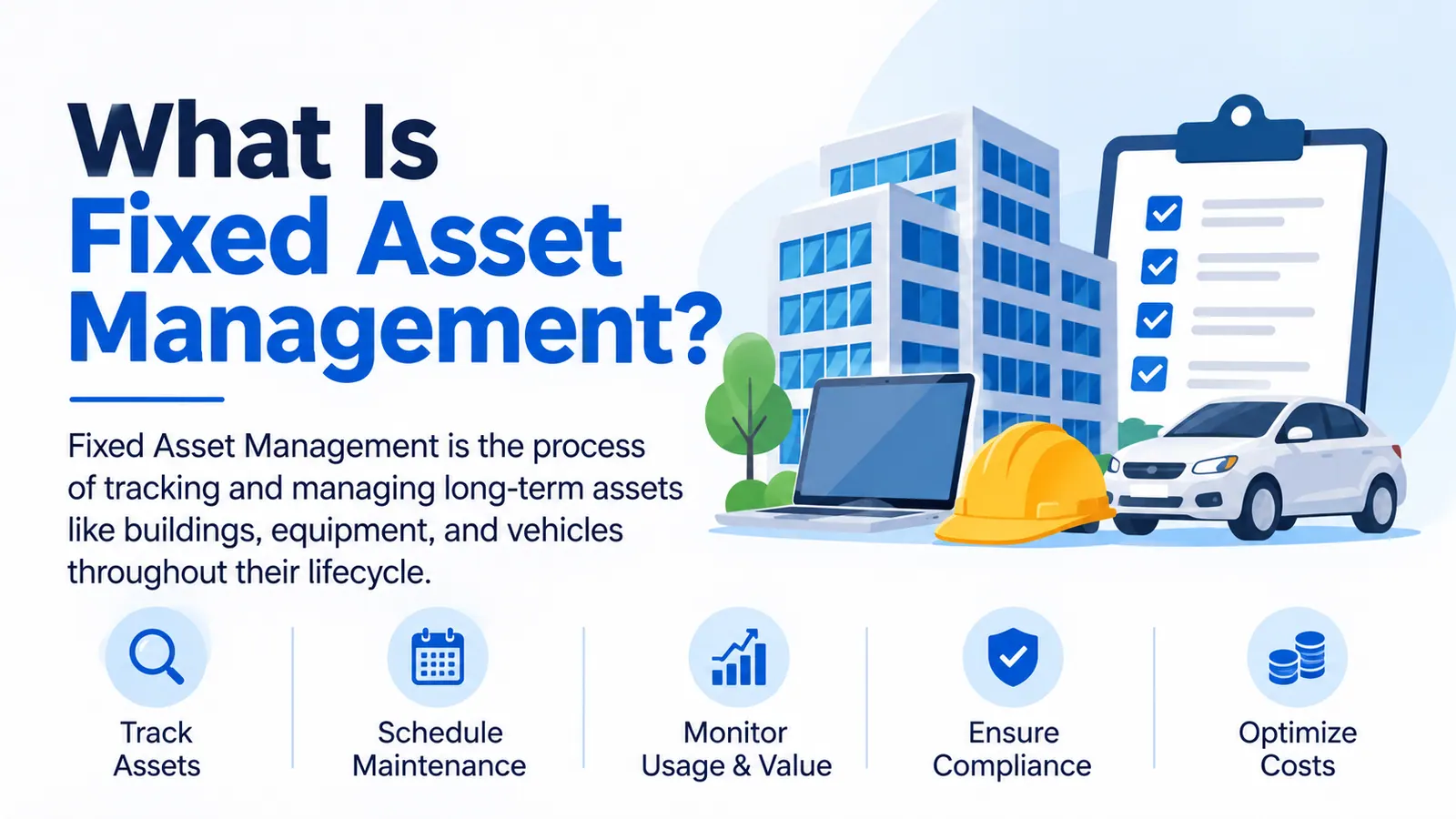
Fixed asset management is the practice of tracking and managing a business's long-term physical assets, from purchase to disposal, covering both the records and the day-to-day care. It keeps your books accurate and your equipment working.
Most businesses own more of these assets than they realize, from machines and vehicles to furniture and buildings. Keeping them under control usually means a mix of good habits and the right asset management software, which stores each item's details in one place. This guide explains what fixed assets are, how the lifecycle works and what good practice looks like. It's written in plain language, for businesses of any size and in any country.
A quick note on how this was put together. We looked at how sources such as IBM, Fiix and NetSuite explain fixed asset management, and noticed that some lean towards maintenance while others lean towards accounting. So we've covered both sides. We haven't given depreciation rates or tax rules, because those differ by country. Firmity is our product, so it gets one short, clearly labeled mention near the end.
What Are Fixed Assets?
Fixed assets are physical items a business owns and uses over a long period, rather than selling them quickly. The usual rule of thumb is that they last more than a year. Think of land, buildings, machinery, vehicles, tools, furniture and office equipment. They're the things that help you do your work, not the things you sell.
It helps to separate them from other kinds of assets. Current assets, such as cash or stock you plan to sell soon, turn over quickly. Intangible assets, such as software licenses or trademarks, have no physical form and are usually handled separately. Fixed asset management focuses on the physical, long-term group.
The Two Sides of Fixed Asset Management
Fixed asset management has two sides, and good teams look after both. The first is the accounting side. It covers keeping a register of what you own, recording what each item cost and how its value changes over time, and noting what happens when it's sold or retired. Accurate records matter for your financial statements, insurance and audits.
The second is the operational side. It's about where each asset is, what condition it's in, who's using it and when it needs servicing. It's the part that keeps equipment working and available. Ignoring either side causes trouble: perfect books don't help if a machine has gone missing, and a well-run storeroom doesn't help if the records don't match. Maintenance-heavy teams often manage this through CMMS software alongside their financial records.
The Fixed Asset Lifecycle, Stage by Stage
Every fixed asset has a life, and managing it means paying attention at each stage. The details vary, but the shape is usually the same:
Acquire: you decide what you need, buy or build it and record the purchase.
Tag and record: you label the asset and create its record with details like location and owner.
Use and maintain: the asset goes into service, and you service and repair it as needed.
Review and transfer: you check it periodically and update records if it moves or changes hands.
Dispose: when it's no longer useful, you retire, sell or scrap it and update the records.
Here's a simple example. A company buys a delivery van, tags it and records its details. It's serviced regularly, and when it changes depot, the record is updated. Years later, it's sold, and the register shows exactly what happened. At every step, the record stays current, so nobody wonders where the van went.
Key Processes in Fixed Asset Management
A few core processes keep the whole system running. Tagging gives each asset a unique label, such as a barcode or QR code, so it can be found and identified. Tracking records where assets are and who's responsible for them. Maintenance, including scheduled preventive maintenance, keeps equipment working longer.
Then there are audits and reconciliations, where you physically check assets against the register and fix differences. Depreciation records show how an asset's value changes over time, and the way you calculate that depends on accounting rules in your country. Finally, disposal records note when and how an asset left the business. Each process feeds the others, which is why gaps in one tend to show up in all.
Want to See Fixed Asset Records on Your Own Equipment?
Reading about the lifecycle is one thing, and seeing your own assets in a proper system is another. If your records live in spreadsheets, you can book a free demo and see how Firmity's asset records, QR codes and service reminders would work for the kind of equipment you track. Tell the team what you're managing today, and they'll reply within 24 hours.
Why Fixed Asset Management Matters
When fixed assets are managed well, a lot of small problems quietly disappear. You know what you own and where it is, so equipment doesn't get lost or bought twice. Maintenance happens on time, so breakdowns are less of a surprise. And your records are ready when someone asks for them, whether that's an auditor, an insurer or your own finance team.
There's a decision-making benefit too. When you can see an asset's age, history and running costs, you can plan repairs and replacements sensibly. Standards such as ISO 55000, the international asset management standard, are centered on getting real value from assets, and tidy fixed asset records are a practical way to support that goal. Over time, better records lead to better choices.
Fixed Asset Management vs Asset Management vs CMMS vs EAM
Term | Focus | How it relates |
|---|---|---|
Fixed asset management | Long-term physical assets, both records and care | The subject of this guide |
Asset management | All assets, physical and otherwise | The broader umbrella that includes fixed assets |
CMMS | Maintenance work, such as work orders and schedules | Handles the care side of fixed assets |
EAM | The whole lifecycle of assets across a large organization | A broader system that often includes fixed asset management |
It's a small family of terms that overlap a lot, which is why they get mixed up. If you want to see how these tools are grouped, it helps to understand the different types of asset management software. Larger organizations often look at enterprise asset management (EAM) when their needs span many sites and departments.
Fixed Asset Management Software: Key Features
Software makes all of this much easier than spreadsheets, and most tools share a core set of features. Here's a quick tour:
Asset register: one central list of every asset, with its details.
Tagging and scanning: labels such as QR codes or barcodes for quick lookup.
Location tracking: where each asset is and when it moves.
Maintenance scheduling: reminders and work orders for servicing.
Depreciation records: a way to record how value changes over time, where the tool covers accounting.
Change log: a record showing who edited an entry and at what time.
Reporting: exports and dashboards for finance, operations and audits.
Not every business needs all of them. A small team might only need a clean register and service reminders, while a larger one may want accounting features too. Match the tool to your size and needs rather than the longest list.
Fixed Asset Management Best Practices
A handful of habits make the biggest difference. Tag everything, so every asset can be found and identified. Give each asset an owner, because items nobody is responsible for tend to drift. Audit regularly, comparing the register with what's physically there, instead of only before a deadline.
Keep records current by updating them when assets move, get repaired or change hands. Review your disposal process, so retired assets don't linger on the register. And keep policies simple and consistent, such as what counts as a fixed asset and who records it. Simple rules that everyone follows beat clever ones that only a few people understand.
Common Challenges
The best-known challenge is the ghost asset, an item that's on the register but can't actually be found. It may have been sold, scrapped or lost, but nobody updated the record. Outdated records are a close cousin, where details like location or owner have changed without being recorded. Both come from the same root problem: updates that depend on memory.
Scattered data is another headache, with details spread across spreadsheets, emails and notebooks. Inconsistent rules about what gets recorded and how can make reports unreliable. The good news is that most of these challenges respond to the same fixes: tag assets, record changes as they happen and audit on a schedule.
Where Firmity Fits In
Since we've covered the physical side of fixed assets, here's a short, honest mention. Firmity's asset tracking is an affordable option for teams that want to keep proper records of their equipment without a heavy enterprise system, and the team can quote for your setup. Each asset gets a single record covering its category, location, status, value and ownership type, and a QR code can open that record with a scan. Service due dates, warranty and AMC expiry and movement history are tracked, and spare parts link back to the asset. It isn't a depreciation or accounting tool, so teams that need those records would pair it with their accounting system, and should ask about regional needs during a demo.
How to Choose Fixed Asset Management Software
Start with some basic facts about your assets. How many do you have, how many locations are involved and who needs to use the system? Then decide how much you need on the accounting side, such as depreciation records, and how much on the operational side, such as maintenance and tracking. Check which other tools it must connect with, like accounting software, and note any regional requirements.
When you have two or three candidates, test each with a small sample of your own assets. Add twenty items, assign a few to colleagues and try finding and updating them. How natural that feels will tell you more than any feature list. If you're comparing options, this roundup of the top asset management software is a handy next read.
Common Mistakes
The most common mistake is skipping the tagging step. Without labels, assets are hard to identify, and records quickly drift from reality. The second is never auditing, so errors pile up unnoticed until a deadline forces a scramble. And the third is treating fixed asset management as purely an accounting task, which leaves the operational side, such as maintenance and location, uncared for.
A smaller trap is trying to do everything at once. Start with your most valuable or most critical assets, get the process working and expand from there. Involve the people who handle equipment every day, since they'll notice problems first. A simple system that people actually use beats a perfect one that nobody follows.
Final Thoughts
Fixed asset management comes down to knowing what you own, where it is and what shape it's in, and keeping your records honest as things change. Start by tagging your key assets, audit on a schedule and let your process grow with you. If you'd like to see how this could work for your own equipment, you can book a free demo with the Firmity team.
FAQs : What is Fixed Asset Management
It's the practice of tracking and managing a business's long-term physical assets, such as machines, vehicles and buildings, through their whole life, including both the records and the care.
Fixed assets are long-term physical items used to run the business, like equipment and buildings. Current assets, such as cash or stock for sale, turn over within a short period.
Asset management is the broader umbrella that covers all kinds of assets. Fixed asset management focuses specifically on long-term physical assets.
Not always. A small business with a few items and one person managing them can use a spreadsheet for now. Software starts to help when assets, locations and people increase.
Author Bio

Syed Aadam
Syed Aadam is a software engineer with a Bachelor's and Master's in Information Technology with a specialization in Artificial Intelligence and Machine Learning. Having trained, and assisted in training foundational ML models for solving frontier scientific problems at the intersection of biodiversity and technology, Syed Aadam has been working to develop AI-enabled CMMS, ERP and CAFM softwares at Ufirm Technologies.