Inventory Management
Types of Inventory: Raw Materials, WIP, Finished Goods, MRO and More
· 9 min read
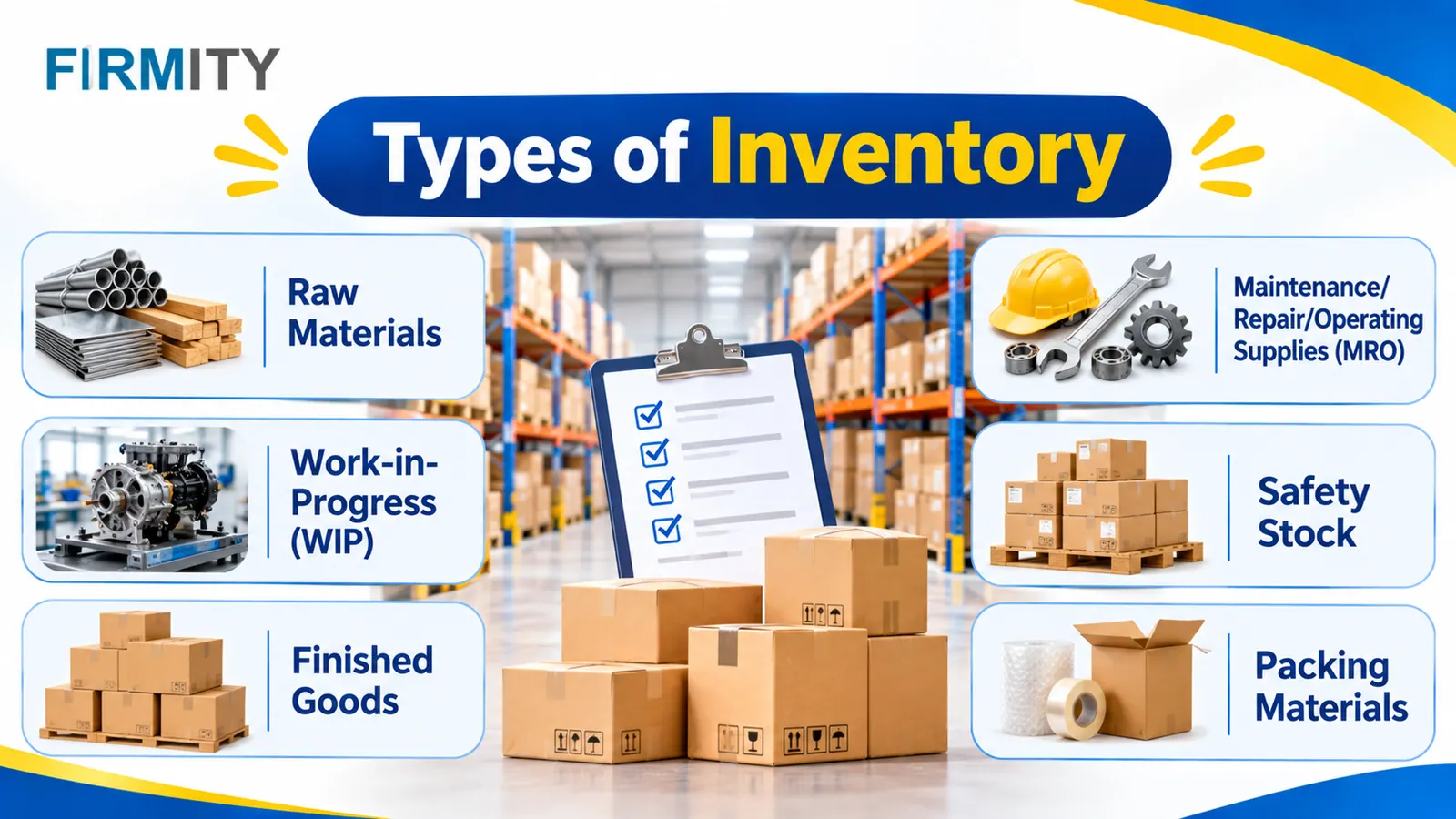
The main types of inventory are raw materials, work in progress, finished goods and MRO supplies. Businesses also group stock by purpose, such as cycle, safety and pipeline stock.
If you’ve ever wondered whether a box of spare bearings counts as inventory, or why one guide lists four types and another lists ten, you’re in the right place. In this guide, we’ll go through each type in plain language with simple examples, show how the two ways of grouping inventory fit together and share one practical tip for managing each type.
Inventory in simple terms
Inventory is the stock a business holds to make, sell or use. That includes the materials that go into a product, the half-finished items on the shop floor, the finished products waiting for customers and the supplies that keep everything running. It’s one of the biggest pieces of money a business has tied up at any moment, which is exactly why it’s worth knowing what kind of stock you actually hold.
Accounting standards use a similar idea. IAS 2 Inventories defines inventories as assets held for sale in the ordinary course of business, assets in the process of production for such a sale, or materials and supplies to be consumed in production or in providing services. In plain terms, that covers finished goods, work in progress, and raw materials and supplies.
Why you’ll see 3, 4 or 10 types of inventory
Search for types of inventory and you’ll find lists of three, four, five or even ten items, all confidently claiming to be right. They’re not wrong, they’re mixing two different questions. One asks what the item is, such as a raw material or a finished product. The other asks why you hold it, such as to cover normal demand or to protect against surprises. Once you separate those two layers, the confusion disappears.
Layer 1: Types of inventory by stage
The first layer is about what the stock is and where it sits in your business. This is the grouping most people mean when they talk about the four main types, and it’s the one your accountant cares about because each stage is valued differently.
Raw Materials
Raw materials are the inputs you use to make a product. Direct raw materials end up in the finished item, like fabric in a shirt. Indirect ones are used up along the way without appearing in it, like lubricants or cleaning supplies. Raw materials depend on suppliers, so the practical tip here is to know your supplier lead times and reorder before you run low.
Work in Progress (WIP)
Work in progress is stock that has started the production journey but isn’t finished. Think of frames cut to size and waiting for assembly. It’s easy to overlook because it isn’t on a shelf, yet it ties up money and shows where production gets stuck. The practical tip is to watch for bottlenecks, since WIP piling up at one stage usually means something downstream is slow.
Finished Goods
Finished goods are complete products ready to sell or ship. Some are made to stock in advance, while others are made to order once a customer asks. Holding too many ties up cash and storage, and holding too few risks lost sales. The practical tip is to match what you hold to real demand and to link stock to dispatch, so you always know what can ship today.
Merchandise (Goods Bought for Resale)
Retailers and distributors don’t make what they sell, they buy it. That stock is usually called merchandise, and it works like finished goods without the manufacturing steps. The practical tip is to watch how fast each item sells. Fast movers need steady replenishment, while slow movers need a review before they turn into dead stock.
MRO Supplies
MRO stands for maintenance, repair and operating supplies. These are the items that keep a business running but don’t become part of the final product: spare parts, tools, lubricants, filters, cleaning supplies and safety gear. They’re easy to neglect until a tiny missing part stops a big machine. The practical tip is to rank items by how critical they are, and keep a safe level of the ones that would halt work.
Quick reference: types by stage
Here’s a quick way to compare the five stage-based types side by side.
Type | What it is | Simple example | What to watch |
|---|---|---|---|
Raw materials | Inputs used to make a product | Fabric, steel sheets, lubricant | Delivery delays from suppliers |
Work in progress | Items partly through production | Frames cut and waiting for assembly | Slow steps that hold up production |
Finished goods | Finished items that are ready for customers | Packed and labeled units ready to ship | Match to demand |
Merchandise | Goods bought for resale | Clothes bought from a supplier for a shop | Sell-through speed |
MRO supplies | Items that keep operations running | Bearings, filters, cleaning supplies | How badly each item's absence would hurt |
Layer 2: Types of inventory by purpose
The second layer is about why you hold the stock. The same item can sit in both layers at once, so a pile of finished goods might also be your safety stock. Here are the purpose-based types you’ll meet most often.
Cycle stock and safety stock. Cycle stock is the inventory you expect to use or sell during a normal replenishment cycle. It’s healthy when it matches demand and supplier lead time. Safety stock is the extra you keep as a buffer for surprises, like a sudden spike in demand or a late delivery. It costs money to hold, so base it on how unpredictable demand and delivery really are, not on gut feeling.
Anticipation stock and pipeline stock. Anticipation stock is built up ahead of a known event, like a seasonal peak, a promotion or an expected price rise. Pipeline stock, sometimes called transit stock, is goods on the move between suppliers, warehouses and customers. You own it but can’t use it yet, so it helps to track it separately and to know how long a journey usually takes.
Decoupling stock and consignment stock. Decoupling stock is a buffer between production stages that run at different speeds, so one slow step doesn’t stall the next. Consignment stock sits in your premises, or a customer’s, but is still owned by the supplier until it’s sold or used. It frees up cash, though it needs clear records of who owns what and when.
Dead or obsolete stock. Dead stock is inventory with little or no chance of being sold or used, such as outdated models or parts for equipment you no longer run. It quietly eats storage space and working capital. Review slow movers regularly, and decide early whether to discount, return, repurpose or write them off.
How the two layers fit together
Every item has a stage and a purpose, and the two don’t compete. A single item can be an MRO supply and safety stock at the same time. Here are a few examples to show how they overlap.
Example | Stage | Purpose |
|---|---|---|
Spare bearings kept in case a delivery is late | MRO supplies | Safety stock |
Fabric ordered ahead of a seasonal peak | Raw materials | Anticipation stock |
Packed goods on a truck between two warehouses | Finished goods | Pipeline stock |
A fast-selling item replenished every month | Merchandise | Cycle stock |
Last year’s model that nobody orders anymore | Finished goods | Dead stock |
Which types matter most for your business?
You don’t need to manage every type with the same intensity. Most businesses have two or three that matter far more than the rest. Use this table to see where your attention is likely to pay off first.
Business | Types that matter most | Why |
|---|---|---|
Manufacturer | Raw stock, unfinished products, completed items, and maintenance supplies | Cost and flow across every production stage |
Retailer or distributor | Merchandise, cycle stock, safety stock, dead stock | Stock has to match sales without piling up |
E-commerce seller | Merchandise, safety stock, pipeline stock | Fast replenishment and goods in transit |
Facility or maintenance team | MRO supplies and critical spares | A missing small part can halt a big machine |
Common mistakes with inventory types
The most common mistake is mixing the two layers. A team might label something as “safety stock” and forget it’s also a raw material, then count it twice or manage it with the wrong rules. Keep both labels on each item, one for what it is and one for why you hold it, and your records stay clear.
Another is ignoring MRO until something breaks. Small spares and consumables don’t look important on a balance sheet, but running out of one can halt a whole line or building. A related slip is keeping dead stock because nobody wants to make the call. Clear records fix most of these, which is one of the everyday benefits of inventory management software, along with setting safety stock using real data instead of guesswork.
MRO Inventory Spotlight: Where Firmity Fits
Of all the types, MRO is the one that facility and maintenance teams live with every day. Spares, consumables and tools are spread across storerooms, sites and buildings, and a missing part means a delayed repair. Most general stock tools are built around products being sold, so it helps to use a system designed for spares and purchasing across facilities.
That’s the job of Firmity’s inventory management software. You can keep an item catalogue with minimum stock levels and reorder alerts, store vendor rate cards, raise purchase orders with approvals and record full or partial deliveries through goods receipt notes. Stock ledgers and transfers show where parts are across properties, and requisitions, purchase orders and receipts stay linked, so there’s a clear trail from purchase to use.
Firmity is also an affordable option, which helps when stock tracking is one of many budget lines. To be fair, its public pages focus on facility spares and purchasing, not on online sales channels, so a business selling products across marketplaces will want a tool built for that.
The bottom line
Types of inventory look confusing until you split them into two layers: what the stock is, and why you hold it. Work out which few types matter most for your business, give each a simple rule and keep clear records. If you look after facilities and want your spares under control, talk to the Firmity team and bring your equipment list.
FAQs : Types of Inventory
It depends on how you count. Most guides list four core types by stage: raw materials, work in progress, finished goods and MRO supplies. Others add types by purpose, like safety, cycle and pipeline stock, which is why you see lists of five to ten.
Raw materials, work in progress, finished goods and MRO supplies. Retailers and distributors often replace the first three with merchandise, meaning goods bought for resale, because they don’t manufacture what they sell.
MRO stands for maintenance, repair and operating supplies. It covers spare parts, tools, lubricants, filters, cleaning and safety items that keep operations running but don’t become part of the final product. How major spares are treated in the books can depend on the item, so check with your accountant.
Cycle stock covers the demand you expect during a normal replenishment cycle. Safety stock is the extra buffer you hold for surprises, like a demand spike or a late delivery. Cycle stock gets used up and replaced, while safety stock sits in reserve.
Yes. Accounting standards such as IAS 2 treat assets in the process of production for sale as inventories, so work in progress counts alongside raw materials and finished goods.
Author Bio

Syed Aadam
Syed Aadam is a software engineer with a Bachelor's and Master's in Information Technology with a specialization in Artificial Intelligence and Machine Learning. Having trained, and assisted in training foundational ML models for solving frontier scientific problems at the intersection of biodiversity and technology, Syed Aadam has been working to develop AI-enabled CMMS, ERP and CAFM softwares at Ufirm Technologies.